Reputation Management
Effortlessly and accurately track the web and social network impact of your brand

Why Visibrain
Our Coverage
The best coverage across the web and social networks
Our Technology
Our intuitive interface uses cutting-edge technology
Our Support
Our team is with you every step of the way
Featured
5 Easy Steps to choose the Right Social Listening Tool

Learn more
Our clients
Brands
Visibrain for brands
Institutions & Local Authorities
Visibrain for institutions and local authorities
Agencies
Visibrain for agencies
Success Stories
Discover how our clients use Visibrain
Client stories
How LVMH is using LinkedIn monitoring to boost its influence with Visibrain

Read the case study
Resources
Blog
Stay up to date
White Papers
Studies, industry analysis and advanced insights
Case studies
Our client stories
Help center
Guides and resources for users
Newsletter
Stay up to date with the latest Visibrain news!
Webinars
Our upcoming webinars.
Our Last Study
Employee Advocacy Tracking Toolkit

Download the full guide
Mamdani's campaign strategy relied heavily on his ability to communicate directly with audiences. His content was highly shareable, often informal and designed to travel beyond his existing followers. This helped him build a recognisable online identity while keeping his communications closely tied to the fast-moving social media cycle.
As mayor, that same online visibility creates a different challenge. The conversation around him is now being shaped, more than ever, by journalists, political opponents and ordinary social media users. A single video can generate hundreds of thousands of mentions in one day.
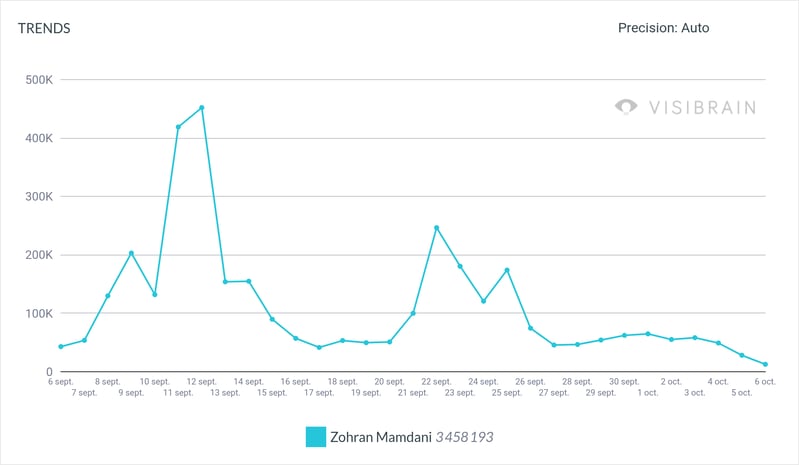
Our data shows two significant spikes in September. The first came on September 11, when conversation reached around 450,000 mentions in a single day. The second can be seen on September 21st, when President Donald Trump visited Mamdani at Gracie Mansion, generating around 250,000 mentions.

On September 11, Mamdani attended the 25th anniversary commemoration of the 9/11 attacks at the World Trade Center Memorial. During the reading of the victims' names, a short video appeared to show Mamdani and Representative Alexandria Ocasio-Cortez smiling and laughing. The clip quickly spread across social media, with critics accusing the pair of behaving disrespectfully during the ceremony. The story was amplified further when Trump criticised the interaction, calling it “terrible” and “inappropriate”.
It was later revealed that this viral clip had been taken vastly out of context. A longer version of the footage showed that Mamdani had been listening to the names before Ocasio-Cortez approached him. Eyewitnesses described the moment as a brief greeting before the pair returned their attention to the ceremony. What's interesting is that the spike in conversation was not necessarily driven by what Mamdani had said or posted himself. It was driven by a narrative about Mamdani, built around a few seconds of footage that could be interpreted very differently depending on the context surrounding it.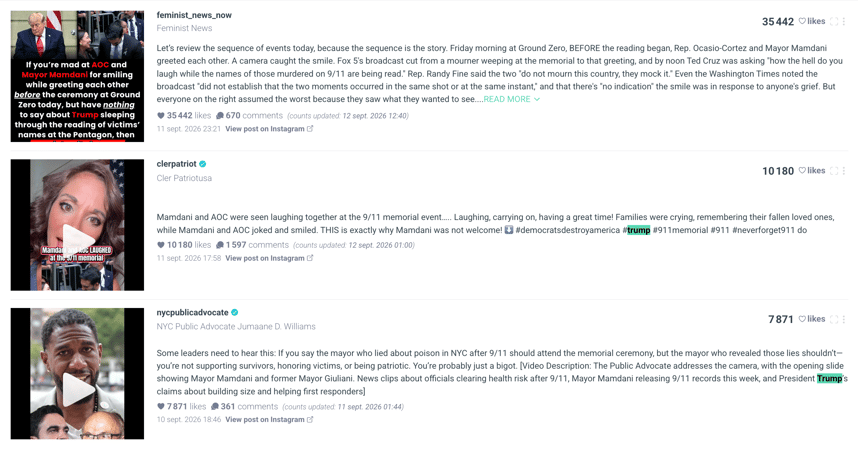
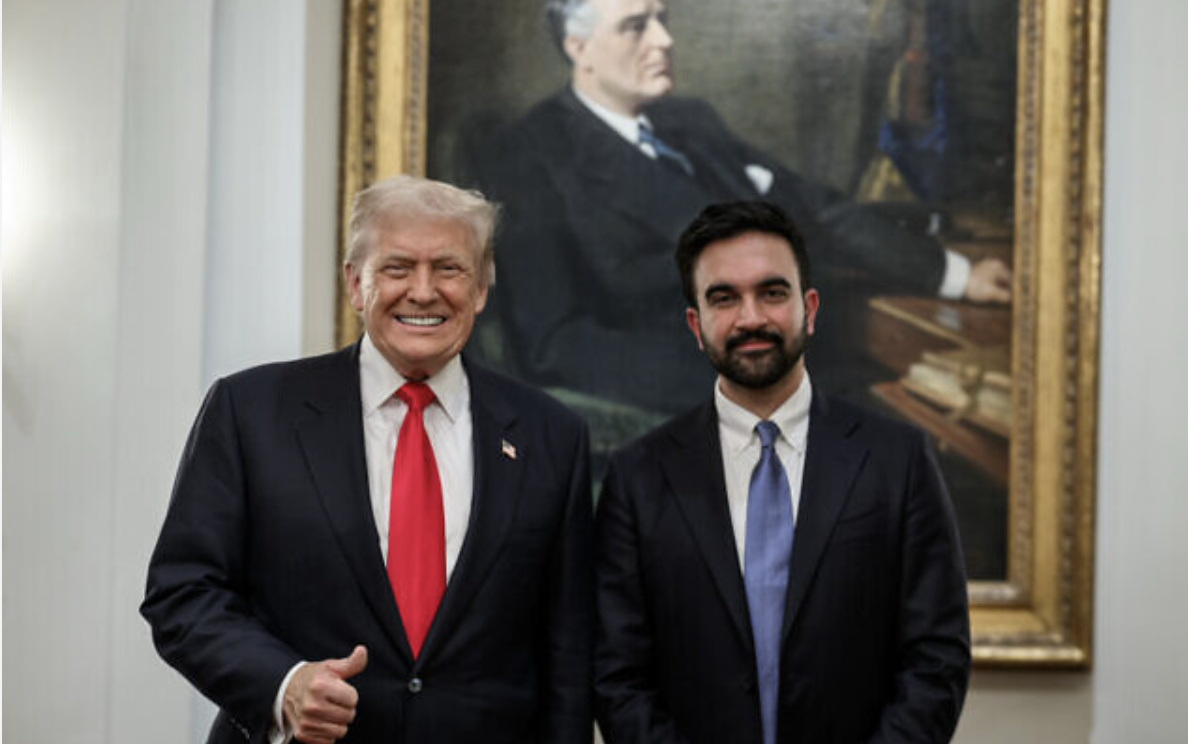
Just ten days later, another major spike showed a different side of Mamdani's new communications environment. On September 21, Donald Trump visited Gracie Mansion for a meeting with the mayor. The two discussed housing, affordability and the development of Sunnyside Yard, while Mamdani reiterated that he was willing to work with anyone who could help deliver for New Yorkers. This meeting generated around 250,000 mentions in a single day.
It was also a very different kind of social media moment from the 9/11 controversy. Images and videos of Trump and Mamdani together circulated widely, while coverage focused on their unexpectedly cordial interaction and their willingness to find common ground on issues including housing and the cost of living. For Mamdani, this is part of the reality of communicating as mayor. His social media presence is no longer operating in a campaign environment where every major moment can be framed around the same political objective. His role now requires him to communicate policy, respond to criticism, work with political opponents and maintain his public image at the same time.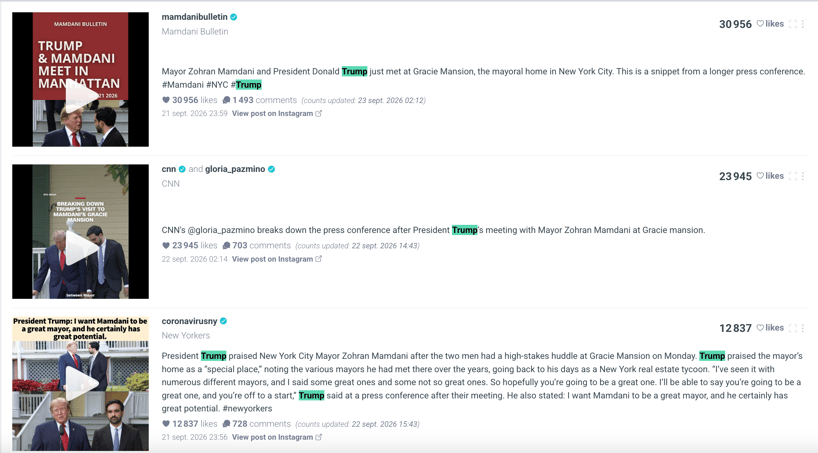
Although the terrain has changed, Mamdani has not abandoned the strategy that was so effective during his campaign. If anything, he has expanded it. His administration continues to invest in social-first communication, including working with content creators and podcast appearances to communicate with New Yorkers. This represents an important evolution.
During his campaign, Mamdani himself was the primary vehicle for his social strategy. Now, his communications ecosystem extends much further beyond his personal accounts. As the number of voices discussing Mamdani grows, so does the importance of understanding what is being said.
When a single video can generate hundreds of thousands of mentions, knowing what content to publish is only one part of the job. Communications teams also need to understand which narratives are gaining traction, who is driving them and how quickly they are spreading. The September 11 controversy is a clear example. The conversation was not sparked by a post from Mamdani's own accounts, yet it became one of the biggest moments for his online presence that month.
The same can be said for his meeting with Trump. The images and footage of the two together generated a huge volume of conversation across social media, much of it happening outside Mamdani's own channels. For a political figure who built his profile by mastering social media, the challenge goes from creating attention-grabbing content, to understanding the conversation when that attention arrives.
Newsletter
.png?width=1090&height=1330&name=CTA%20newsletter%20(1).png)