Reputation Management
Effortlessly and accurately track the web and social network impact of your brand

Why Visibrain
Our Coverage
The best coverage across the web and social networks
Our Technology
Our intuitive interface uses cutting-edge technology
Our Support
Our team is with you every step of the way
Featured
5 Easy Steps to choose the Right Social Listening Tool

Learn more
Our clients
Brands
Visibrain for brands
Institutions & Local Authorities
Visibrain for institutions and local authorities
Agencies
Visibrain for agencies
Success Stories
Discover how our clients use Visibrain
Client stories
How LVMH is using LinkedIn monitoring to boost its influence with Visibrain

Read the case study
Resources
Blog
Stay up to date
White Papers
Studies, industry analysis and advanced insights
Case studies
Our client stories
Help center
Guides and resources for users
Newsletter
Stay up to date with the latest Visibrain news!
Webinars
Our upcoming webinars.
Our Last Study
Employee Advocacy Tracking Toolkit

Download the full guide

In the social media landscape, the term “astroturfing” is used to describe a form of manipulation. Guillaume Sylvestre introduces it with this definition: “Astroturfing is a phenomenon based on a single idea: to make people believe in a spontaneous, massive movement that comes from the ‘grassroots’ and is therefore necessarily legitimate.”
He continues this description by saying, “Astroturfing, in short, is an operation carried out by fake accounts to generate buzz, or by activists or professionals who are paid to influence public debate.”
In 2024, with the help of social media and the internet, it’s easy to launch astroturfing campaigns. Guillaume Sylvestre highlights a system centered on two types of profiles: “alphas” and “betas.”
“Alphas” have a very specific role, explains Guillaume Sylvestre: “These are accounts designed to become influential on their topics, to establish legitimacy through their posts, which allows them to gain widespread traction and visibility very quickly.”
As for the “betas,” these are profiles that “support certain figures, but above all, attack their detractors in packs, with a barrage of messages, ” explains our speaker.
Beyond the phenomenon of manipulation, astroturfing can also be used to support companies or stakeholders who are facing difficulties or under attack at a given moment.
“I’ve long analyzed the episodes of *Cash Investigation*, which take a very aggressive, anti-corporate stance, ” explains Guillaume Sylvestre.
He cites the example of Limagrain, which was under attack during an episode about seed companies. The company decided to enlist various influencers to spread its message. These influencers were already active in the glyphosate debate against Elise Lucet, so Limagrain was supported by a large community on social media.
Guillaume Sylvestre highlights conspiracy theorists as the most effective astroturfers. He elaborates: “These actors have highly structured communication strategies, and all these conspiracy theories are amplified on social media.”
He continues, “For a very long time, YouTube’s algorithm promoted videos about conspiracy theories (such as those regarding September 11, 2001). In particular, a few years ago, I mapped American discussions about vaccines. As we can see in the map below, several communities stand out.”
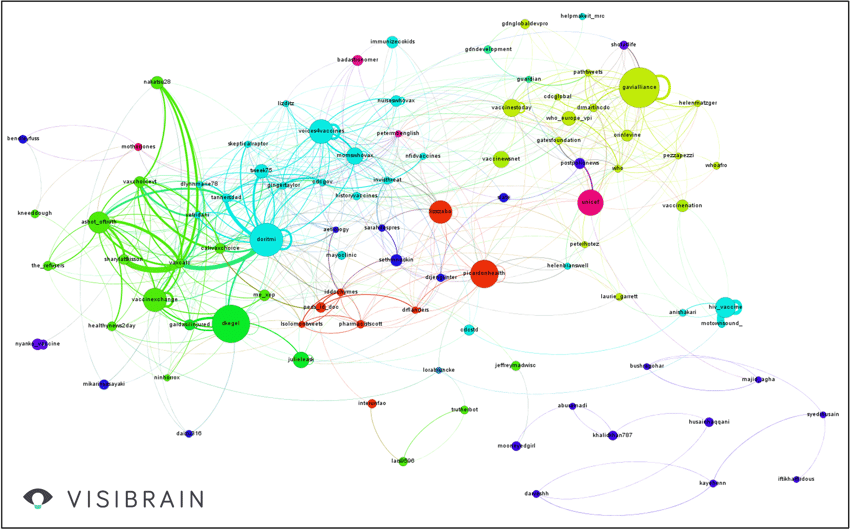
“ The effectiveness of this strategy of targeting different profiles of concerned individuals stems from the fact that vaccine advocates didn’t see it coming, ” explains Guillaume Sylvestre.
He continues, “We also see, on the far right, official stakeholders communicating among themselves. Their messages don’t reach other communities, and that’s why these theories were able to spread so easily and why we’ve seen so many issues surrounding vaccinations.”
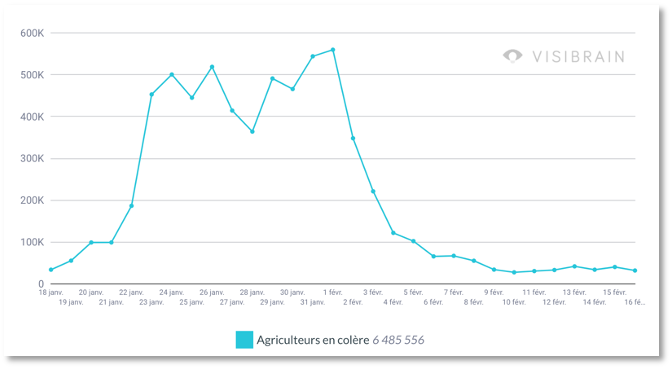
Another example is the #agriculteursencolère movement (which translates to "angry farmers" from French). The question of whether debates on X/Twitter surrounding this issue were manipulated is a legitimate one. It generated millions of posts. Guillaume Sylvestre highlights an important aspect of this current issue: “The movement’s leaders, the farmers, aren’t necessarily active on X or Twitter.”
The volume of posts published about this movement is substantial on Elon Musk’s social network. As proof, more than 6.5 million posts were shared in one month regarding the farmers’ protest. That’s twice as many as were posted about pension reform, which was already widely discussed at the time.
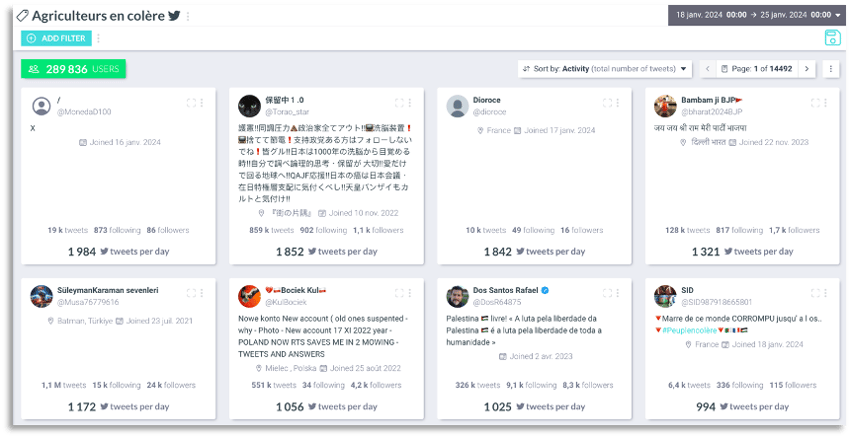
“Using the Visibrain tool, it’s easy to identify accounts that are particularly active on this topic,” continues Guillaume Sylvestre. Here, we observe that several profiles were created recently, producing up to nearly 2,000 posts per day, suggesting manipulation, as we can see from the users commenting on the topic below (an observation made by Thierry Herrant on the Visibrain blog).
Guillaume Sylvestre sums up the phenomenon in one sentence: “ Astroturfing can be exploited by anyone, by any actor, and on any topic.”
He outlines the indicators of astroturfing to watch for:
A mobilization of questionable scale, with profiles posting more than 100 tweets per day, confirmed by the manipulation coefficient of interactions
An increased presence of anonymous profiles (lack of personal information, aliases active on only one social network, focus on a single topic, coordination with other similar actors, etc.)
A narrative centered on specific arguments that recur constantly among these actors, with specific coordination
Newsletter