Reputation Management
Effortlessly and accurately track the web and social network impact of your brand

Why Visibrain
Our Coverage
The best coverage across the web and social networks
Our Technology
Our intuitive interface uses cutting-edge technology
Our Support
Our team is with you every step of the way
Featured
5 Easy Steps to choose the Right Social Listening Tool

Learn more
Our clients
Brands
Visibrain for brands
Institutions & Local Authorities
Visibrain for institutions and local authorities
Agencies
Visibrain for agencies
Success Stories
Discover how our clients use Visibrain
Client stories
How LVMH is using LinkedIn monitoring to boost its influence with Visibrain

Read the case study
Resources
Blog
Stay up to date
White Papers
Studies, industry analysis and advanced insights
Case studies
Our client stories
Help center
Guides and resources for users
Newsletter
Stay up to date with the latest Visibrain news!
Webinars
Our upcoming webinars.
Our Last Study
Employee Advocacy Tracking Toolkit

Download the full guide
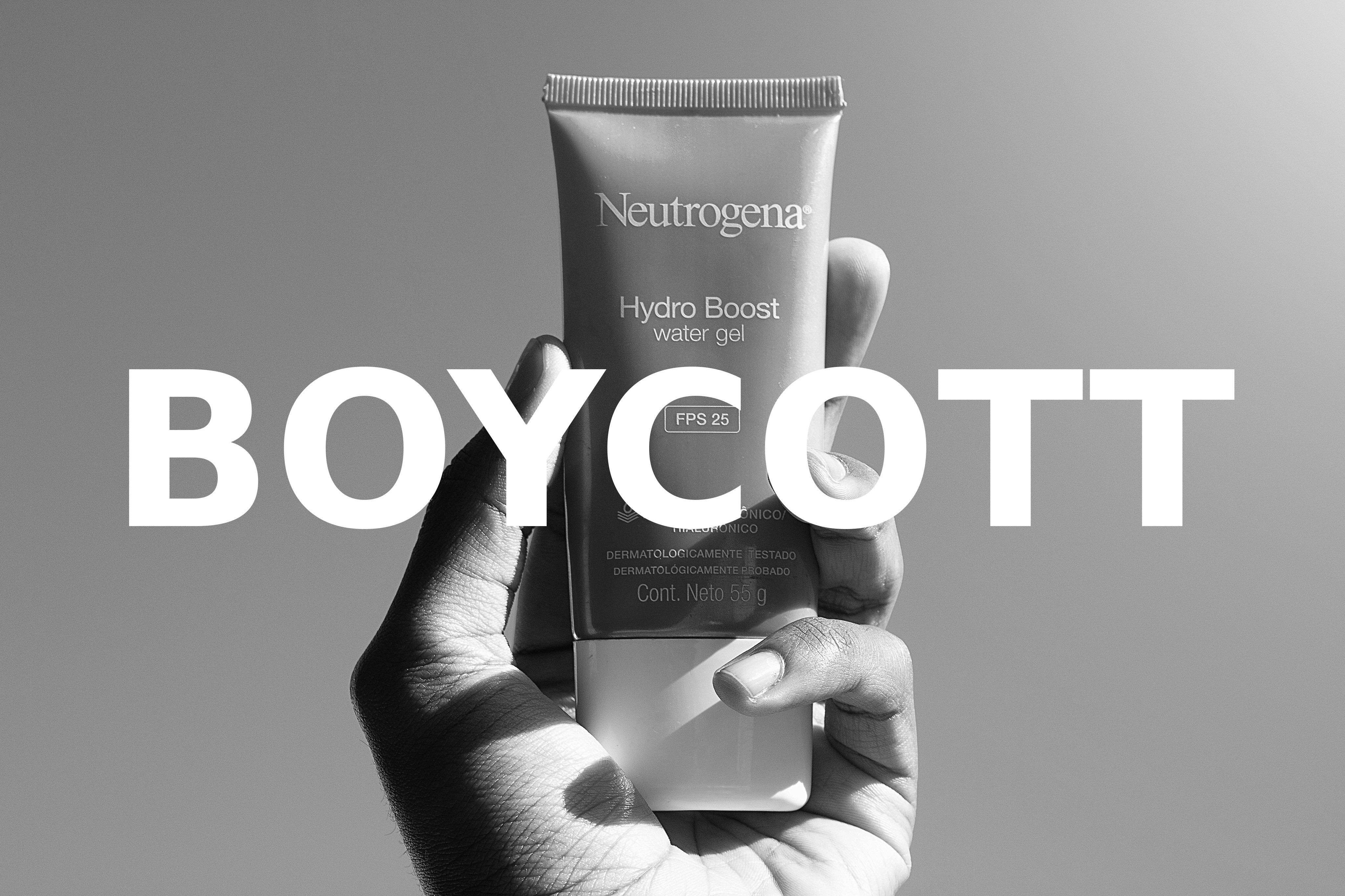
Panettiere worked with Neutrogena for around a decade. In 2015, she spoke publicly about experiencing postpartum depression following the birth of her daughter. In her 2026 memoir and subsequent interviews, Panettiere revealed that Neutrogena wanted to end their partnership after she publicly discussed her mental health. She said her representative intervened, arguing that the company could not terminate her for speaking about her experience, but that she knew the relationship would not continue.
The story was not new.
However, following Panettiere's death on 16 August, clips and reports relating to her experience with Neutrogena began circulating across social media. An old story was pulled back into the spotlight and interpreted through a new moment in time. Within days, the story had become a significant reputational conversation for Neutrogena.

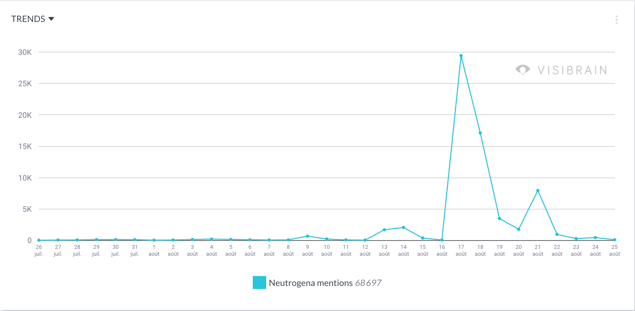
The scale of the conversation shows just how quickly a dormant reputational issue can become a live crisis. Over the past 30 days, Neutrogena generated 68,697 mentions, with the conversation reaching a peak of almost 30,000 mentions on 17 August, following the news of Panettiere's death on 16 August.
Her previous comments about Neutrogena were rapidly resurfaced, with social users and media outlets revisiting her account of how the decade-long partnership ended.
A second, smaller rise on 21 August came shortly after Neutrogena publicly addressed the backlash.
The sentiment analysis is perhaps even more striking: 71.4% of mentions were classified as negative.
This gives us a useful picture of the crisis unfolding in real time: an initial spark, a major escalation as the story enters the mainstream, and a second spike as the brand responds. That's exactly the kind of pattern social listening can help communications teams identify, not just how much people are talking, but what is causing the conversation to change direction.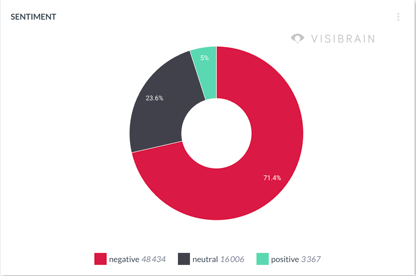
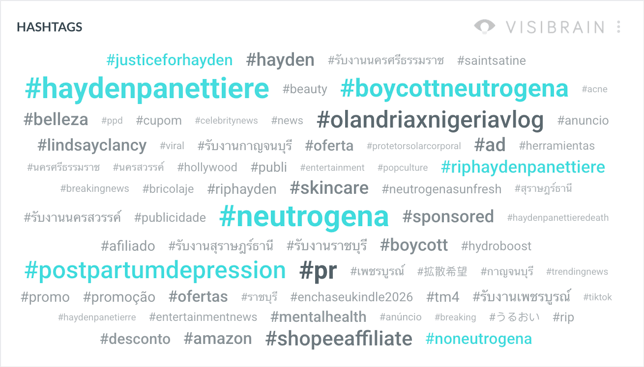
The hashtags associated with the conversation provide another indication of how the narrative developed. Among the most prominent were #BoycottNeutrogena, #Boycott and #JusticeForHayden. This is significant because hashtags can reveal the direction a conversation is taking before looking at individual posts.
In this case, the language was not simply about discussing Panettiere's experience. #BoycottNeutrogena is a direct call for consumer action, while #JusticeForHayden frames the conversation around accountability.
The presence of multiple boycott-related hashtags suggests that the backlash had moved beyond criticism of a historical decision and towards a large-scale rejection of the brand.
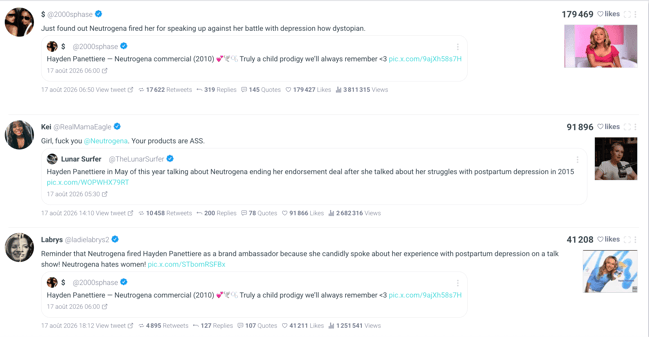
Neutrogena initially chose not to comment publicly, explaining that it wanted to respect Panettiere's family and loved ones following her death. The brand subsequently addressed the backlash on 20 August. Rather than directly contesting Panettiere's account, Neutrogena acknowledged the impact its actions had on her. In its statement, the brand said:
“We are proud to have partnered with her and understand that we made her feel unsupported during a very difficult time. This is not what Neutrogena stands for or who we want to be.”
The brand also recognised Panettiere's role in raising awareness around postpartum depression and announced that it was making a “significant investment” in a long-standing community health partner to give more women access to support, including care for postpartum depression.
The response is notable for what it doesn't do. Neutrogena does not publicly dispute Panettiere's account or attempt to distance itself from the events of 2015. Instead, it acknowledges that she felt unsupported, reinforces the brand's current position and pairs its statement with a commitment to action.
The Neutrogena case highlights an uncomfortable reality for communications teams: the absence of a current crisis doesn't necessarily mean the absence of reputational risk. Brands have long histories. Old campaigns, former partnerships, controversial decisions and past comments can sit quietly online for years before something brings them back into the spotlight.
You can't predict exactly what will trigger that resurgence. But you can monitor the conversations around your brand and understand the narratives that already exist. That's where social listening becomes a strategic reputation-management tool. By tracking changes in volume, sentiment, hashtags and the people driving conversations, communications teams can spot when a historical issue starts gaining momentum, and understand what is driving it.
The lesson isn't that brands should spend their time looking for problems in their past. It's that you don't always know which part of your past could become relevant tomorrow. You can't control what happened ten years ago, or when someone decides to bring it back. But you can make sure you're listening when they do.
Newsletter
.png?width=1090&height=1330&name=CTA%20newsletter%20(1).png)