Reputation Management
Effortlessly and accurately track the web and social network impact of your brand

Why Visibrain
Our Coverage
The best coverage across the web and social networks
Our Technology
Our intuitive interface uses cutting-edge technology
Our Support
Our team is with you every step of the way
Featured
5 Easy Steps to choose the Right Social Listening Tool

Learn more
Our clients
Brands
Visibrain for brands
Institutions & Local Authorities
Visibrain for institutions and local authorities
Agencies
Visibrain for agencies
Success Stories
Discover how our clients use Visibrain
Client stories
How LVMH is using LinkedIn monitoring to boost its influence with Visibrain

Read the case study
Resources
Blog
Stay up to date
White Papers
Studies, industry analysis and advanced insights
Case studies
Our client stories
Help center
Guides and resources for users
Newsletter
Stay up to date with the latest Visibrain news!
Webinars
Our upcoming webinars.
Our Last Study
PR Crises in the AI Era

Download the full guide

According to Visibrain data, AI slop was mentioned more than 475,000 times in the past 30 days across the four platforms analysed. While it is difficult to ascertain it's exact origin, the term gained traction primarily on X. What initially appeared to be a niche expression has quickly become a widely shared label for dissatisfaction with the current state of AI-generated content.
Beyond raw volume, the number of platforms involved points to a poignant issue rather than a fleeting trend. Visibrain’s cross-platform monitoring shows that AI slop is not confined to a single community, but resonates with audiences reacting to the same underlying concern: a loss of content quality driven by automation and the use of AI tools.
Although the conversation around AI slop has been growing for months, Visibrain’s timeline analysis shows a clear peak on 11 December, when more than 37,000 posts mentioning AI slop were published. The immediate cause of this surge was McDonald’s decision to remove its AI-generated Christmas advert in the Netherlands after intense online backlash. The 45-second commercial, titled “It’s the Most Terrible Time of the Year,” used generative AI to portray chaotic holiday scenes and suggested that viewers might be better off escaping December stress at McDonald’s. The ad was pulled just days after its release amid widespread criticism of both its tone and its AI delivery.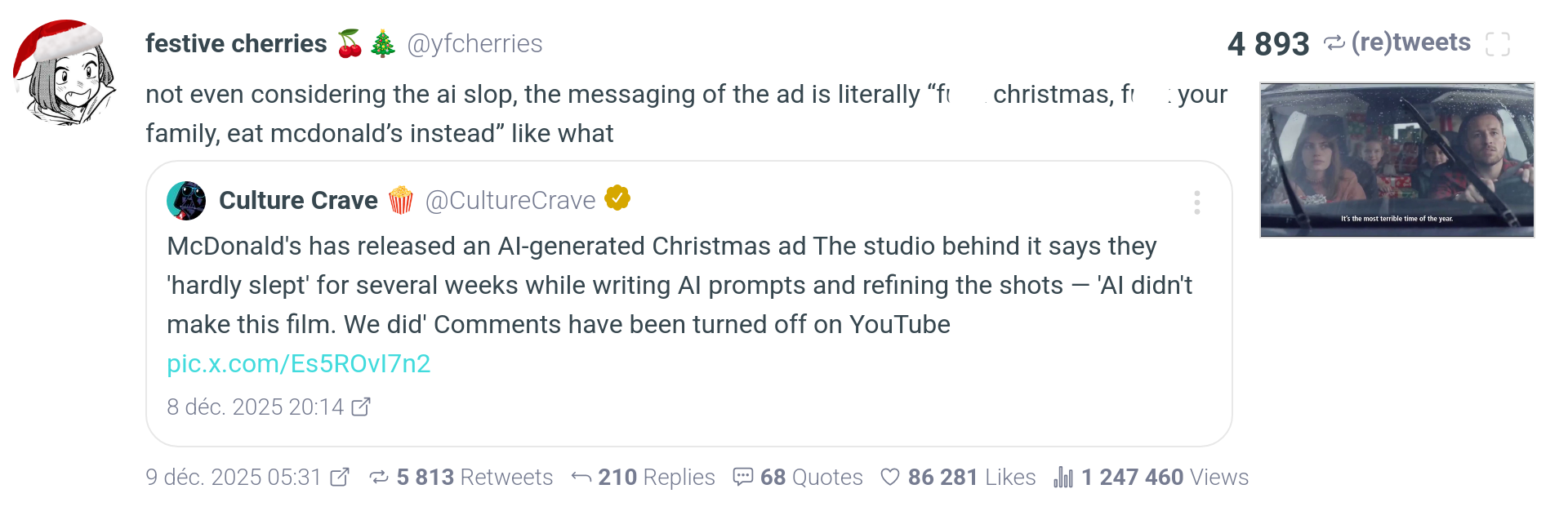
McDonald’s was not alone in experimenting with AI for holiday advertising. Coca-Cola’s 2025 Christmas campaign also relied on generative AI to produce visuals and narrative elements for its “Holidays Are Coming” spot. This too became a talking point online. Critics on social platforms disparaged the Coke ad for lacking the warmth and human touch of its predecessors and questioning why a brand with such iconic advertising heritage would lean on AI-generated content in the first place..png?width=1920&height=504&name=30b35c50-0abe-44e4-ad5b-1bd7cd345909_202511181439_202512181439_item%20(1).png)
Sentiment analysis conducted via Visibrain indicates that 28.9% of AI slop mentions are negative. For a term rooted in commentary rather than crisis, this level of negativity is significant. Looking at the language within those posts, much of the negativity is directed not at AI as a technology, but at how it is being deployed..png?width=549&height=380&name=30b35c50-0abe-44e4-ad5b-1bd7cd345909_202511181439_202512181439_Sentiment%20(1).png)
(Visibrain platform - sentiment analysis)

One of the most notable insights from Visibrain’s hashtag analysis is the emergence of #supporthumanart as a dominant co-occurring hashtag within the AI slop conversation on X. Visibrain data shows that a significant share of posts criticising AI-generated content do not stop at rejection; instead, they actively redirect attention towards illustrators, designers, photographers and other creatives.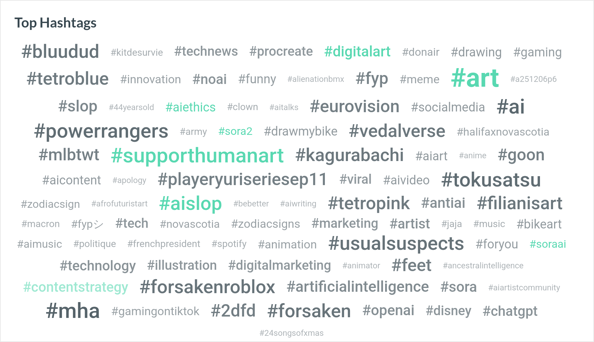
This raises an interesting hypothesis: the influx of AI-generated content may be accelerating, rather than eroding, appreciation for human creativity. As automated output becomes more widespread, its limitations become more visible, prompting audiences to seek out and celebrate work that feels distinctly human. For brands and marketing teams, this shift could signal an emerging trend for 2026 and beyond where AI serves as a catalyst for reasserting the value of human-led creativity in brand storytelling.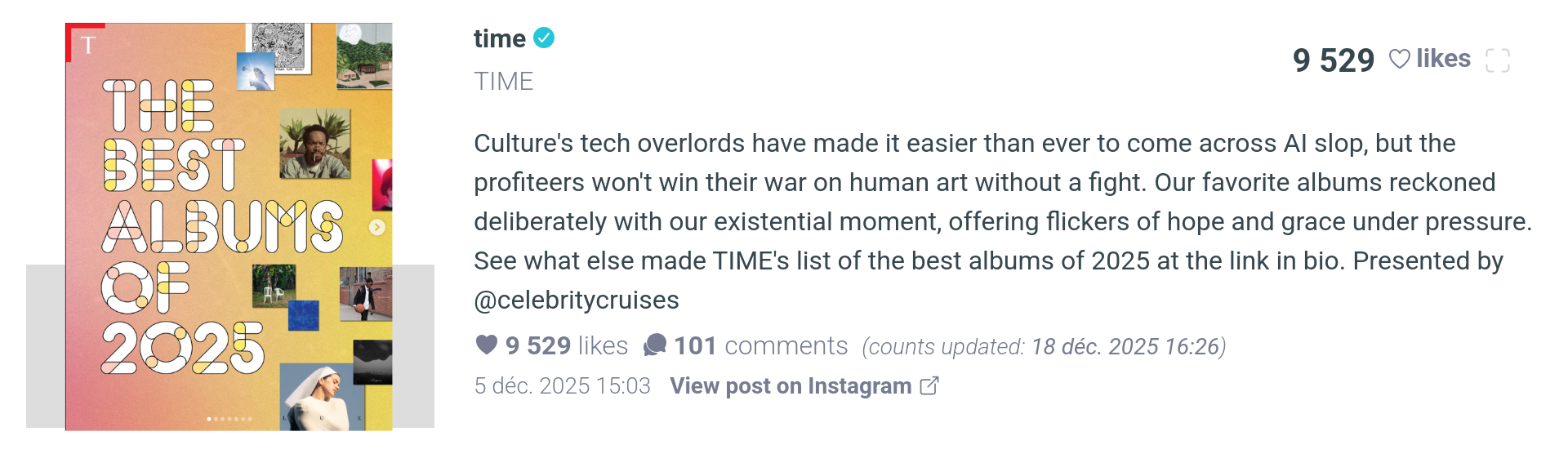
For brands experimenting with generative AI, the AI slop conversation offers a clear lesson. Visibrain’s monitoring shows how quickly criticism can escalate when audiences perceive automation as a shortcut rather than an enhancement.
More broadly, tracking terms like AI slop demonstrates the value of social listening beyond brand mentions alone. By identifying emerging language, sentiment shifts and cultural flashpoints, tools like Visibrain help organisations understand not just what audiences are reacting to, but why those reactions are taking shape.
Newsletter
.png?width=1090&height=1330&name=CTA%20newsletter%20(1).png)