Reputation Management
Effortlessly and accurately track the web and social network impact of your brand

Why Visibrain
Our Coverage
The best coverage across the web and social networks
Our Technology
Our intuitive interface uses cutting-edge technology
Our Support
Our team is with you every step of the way
Featured
5 Easy Steps to choose the Right Social Listening Tool

Learn more
Our clients
Brands
Visibrain for brands
Institutions & Local Authorities
Visibrain for institutions and local authorities
Agencies
Visibrain for agencies
Success Stories
Discover how our clients use Visibrain
Client stories
How LVMH is using LinkedIn monitoring to boost its influence with Visibrain

Read the case study
Resources
Blog
Stay up to date
White Papers
Studies, industry analysis and advanced insights
Case studies
Our client stories
Help center
Guides and resources for users
Newsletter
Stay up to date with the latest Visibrain news!
Webinars
Our upcoming webinars.
Our Last Study
Employee Advocacy Tracking Toolkit

Download the full guide

Unlike typical health-related discussions, which tend to spread across multiple platforms, cadmium-related content remains disproportionately active on X. Other platforms show comparatively limited engagement, suggesting that the topic has not yet reached mainstream, cross-platform traction.
This type of asymmetry is a key signal in social listening. High volumes on a single platform do not necessarily indicate widespread awareness, they may instead reflect platform-specific dynamics, where certain narratives gain traction within specific user groups.
Before analysing the structure of the online conversation, it is important to recognise that the cadmium issue is grounded in legitimate concerns.
In France, cadmium contamination, particularly in food products, has led to increased scrutiny from public authorities and health experts. The issue has also entered the legal sphere, with companies facing collective legal action linked to alleged exposure risks.
This real-world context is reflected in the evolution of online conversations, which show repeated spikes in attention over time.
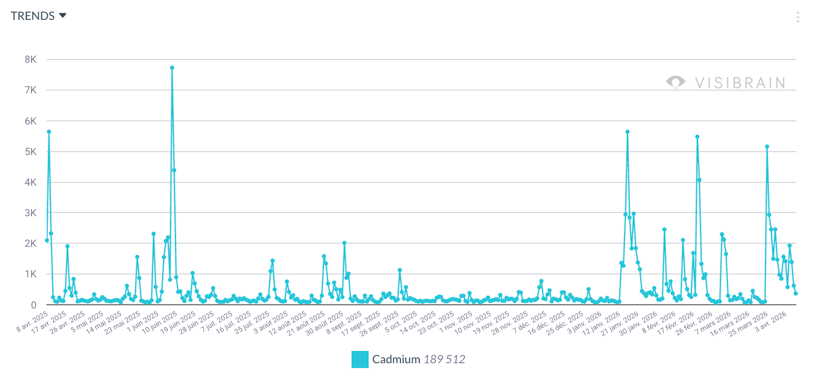
Rather than a steady increase in discussion, the topic evolves through short, intense bursts of activity, each corresponding to specific real-world developments—particularly media coverage and legal actions linked to cadmium exposure in France.
To understand how the cadmium conversation is structured on X, interactions between accounts were mapped to identify communities and key amplification nodes.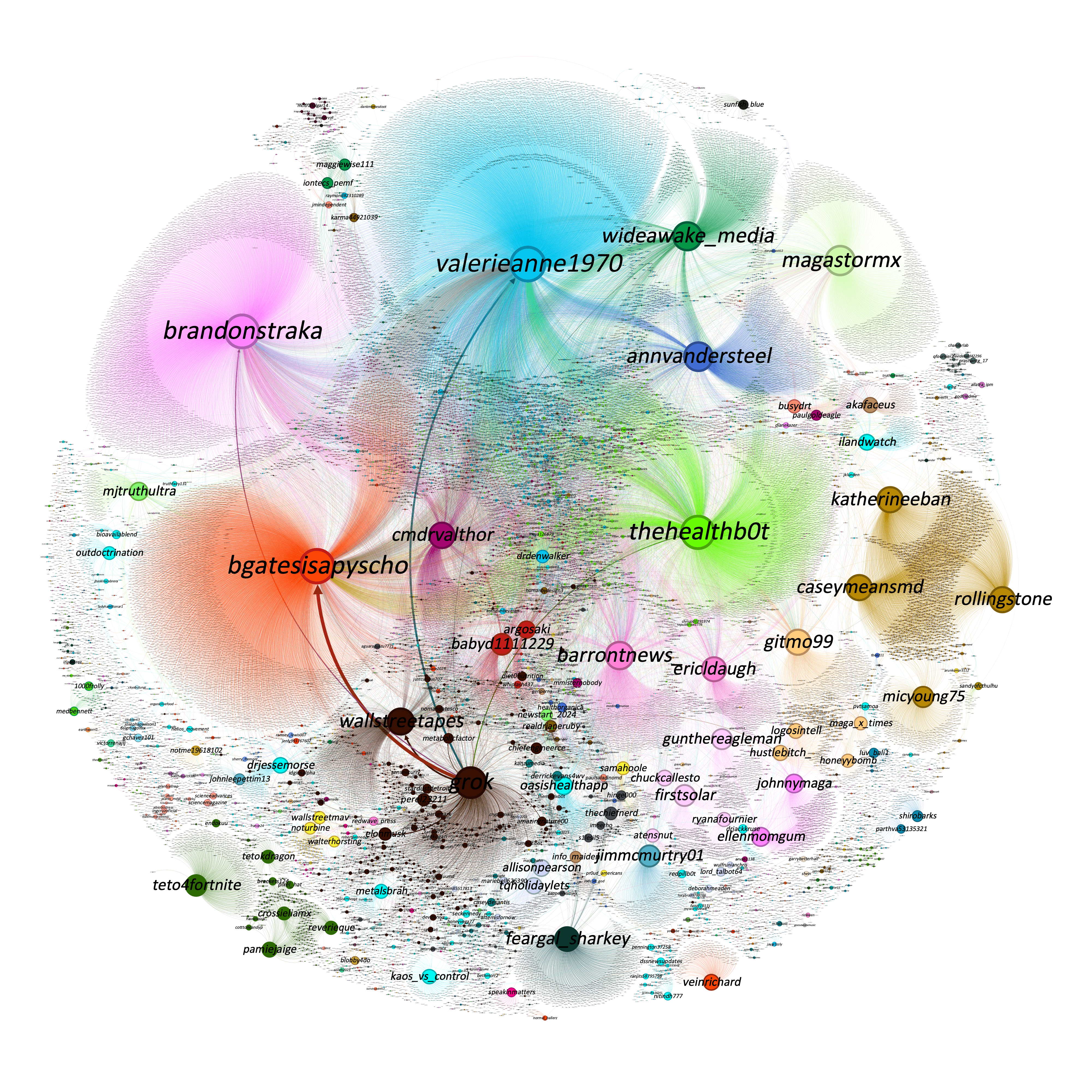
The map reveals a highly fragmented conversation, structured around several dense and internally connected communities. Rather than a unified public discussion, the topic is driven by clusters that interact heavily within their own networks but show limited crossover with others.
A small number of highly connected accounts act as central nodes, concentrating and redistributing information within their respective communities. At the same time, the limited connections between clusters suggest the presence of relatively isolated ecosystems, each shaping its own version of the narrative.

One of the key risks highlighted by this case is the potential for misinterpreting volume as impact.
A spike in mentions is often an indicator of:
However, without analysing who is driving the conversation, these conclusions can be misleading.
In the case of cadmium:
For organisations, reacting to these signals without deeper analysis can lead to disproportionate or misaligned communication strategies.
The cadmium conversation reflects a broader shift in how online narratives emerge and evolve.
Not all digital spikes indicate a mainstream crisis. Some are the result of highly active, tightly connected communities that dominate visibility on specific platforms without achieving widespread reach.
For PR professionals, this reinforces the importance of moving beyond surface-level metrics. Effective social listening requires:
Only by combining these layers of analysis can organisations accurately assess whether an issue represents a genuine reputational threat, or a contained but highly visible online dynamic.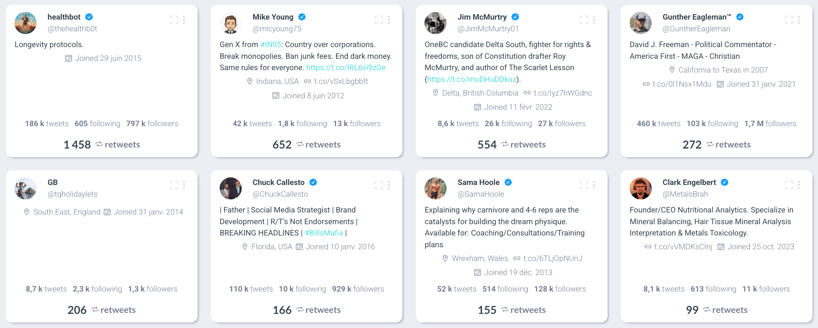
In an increasingly fragmented media landscape, visibility does not always equate to reach, and volume does not always equate to impact.
The cadmium case illustrates a critical evolution in digital communication: understanding who shapes the conversation is now just as important as understanding how much conversation there is.
Newsletter
.png?width=1090&height=1330&name=CTA%20newsletter%20(1).png)