Reputation Management
Effortlessly and accurately track the web and social network impact of your brand

Why Visibrain
Our Coverage
The best coverage across the web and social networks
Our Technology
Our intuitive interface uses cutting-edge technology
Our Support
Our team is with you every step of the way
Featured
5 Easy Steps to choose the Right Social Listening Tool

Learn more
Our clients
Brands
Visibrain for brands
Institutions & Local Authorities
Visibrain for institutions and local authorities
Agencies
Visibrain for agencies
Success Stories
Discover how our clients use Visibrain
Client stories
How LVMH is using LinkedIn monitoring to boost its influence with Visibrain

Read the case study
Resources
Blog
Stay up to date
White Papers
Studies, industry analysis and advanced insights
Case studies
Our client stories
Help center
Guides and resources for users
Newsletter
Stay up to date with the latest Visibrain news!
Webinars
Our upcoming webinars.
Our Last Study
PR Crises in the AI Era

Download the full guide
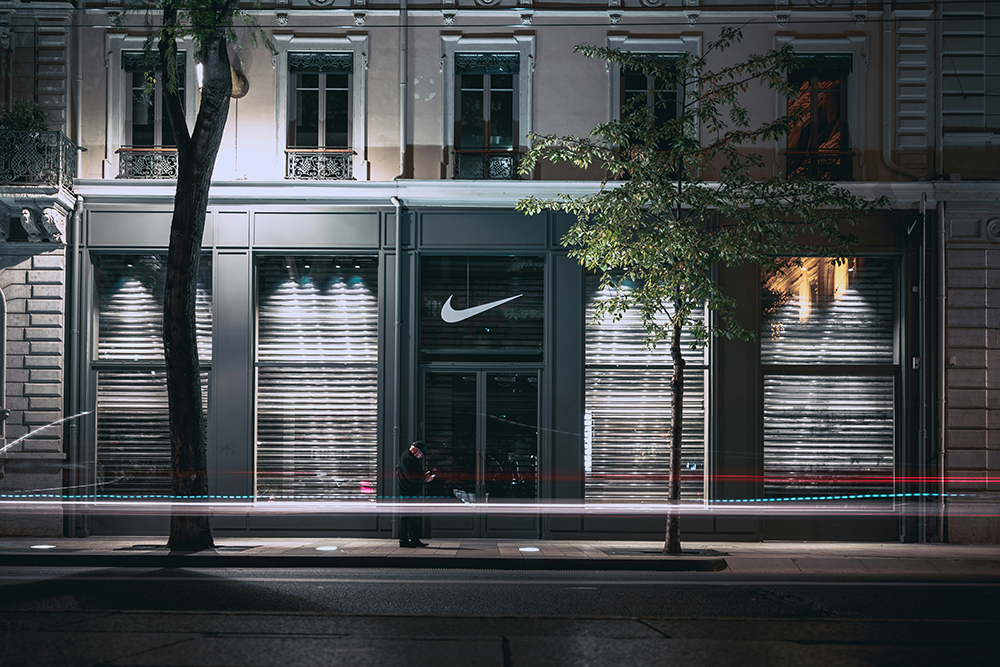
Just days after appearing on the streets of Boston, Nike’s campaign was already generating significant attention, but not necessarily for the right reasons. Installed notably on its Newbury Street store, the billboard quickly set social media alight, from X to Instagram, as well as LinkedIn and TikTok.
At the centre of the backlash: the slogan “Runners welcome. Walkers tolerated.”, widely perceived as divisive. The brand’s messaging drew substantial criticism, with many users calling out what they saw as overt elitism, fuel for a viral controversy.
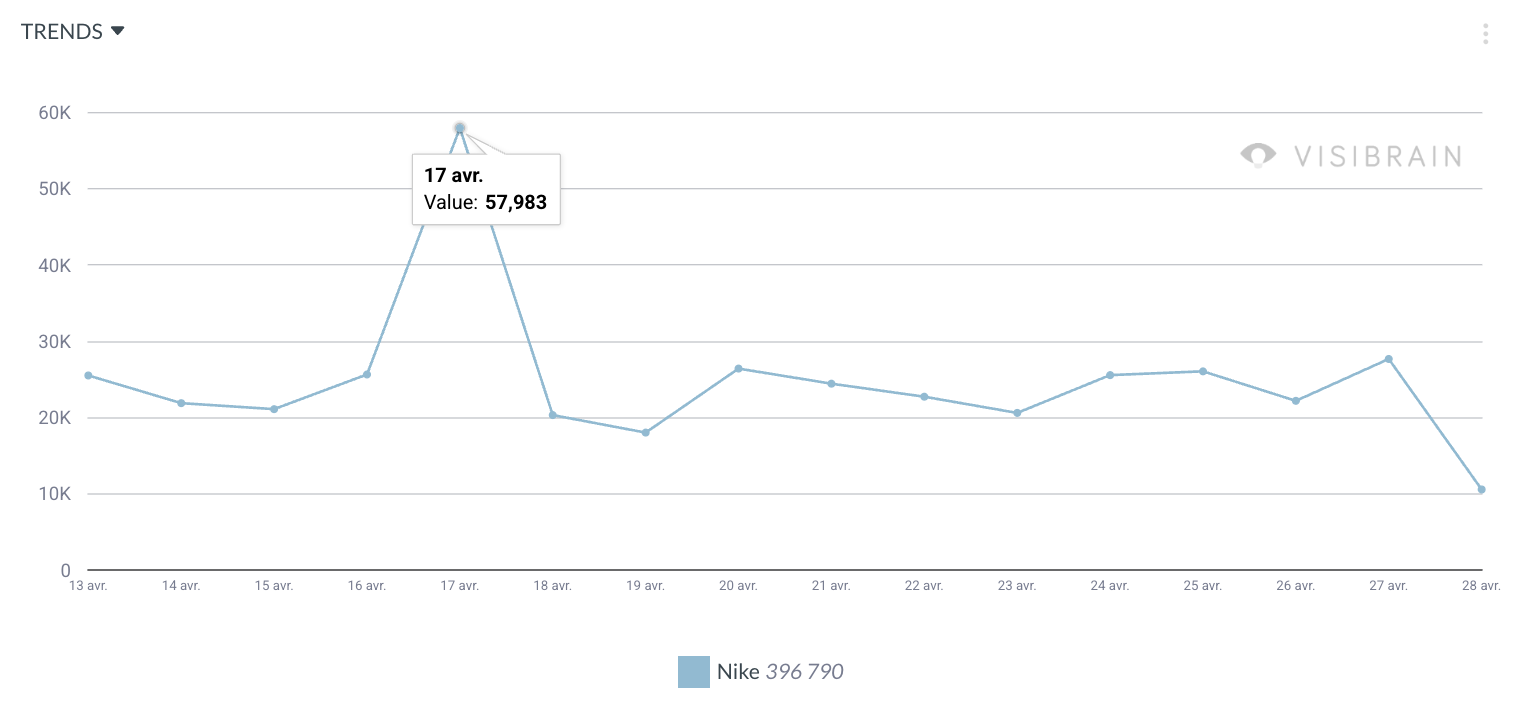
Since 13 April, Nike has generated more than 396,000 online mentions. A particularly notable spike occurred at the height of the campaign, with 57,983 posts in a single day - nearly double its usual daily volume. That day alone accounts for approximately 15% of total mentions over the period analysed.
The outcome is a campaign that proved impossible to ignore, illustrating the narrow boundary between marketing impact and reputational risk.
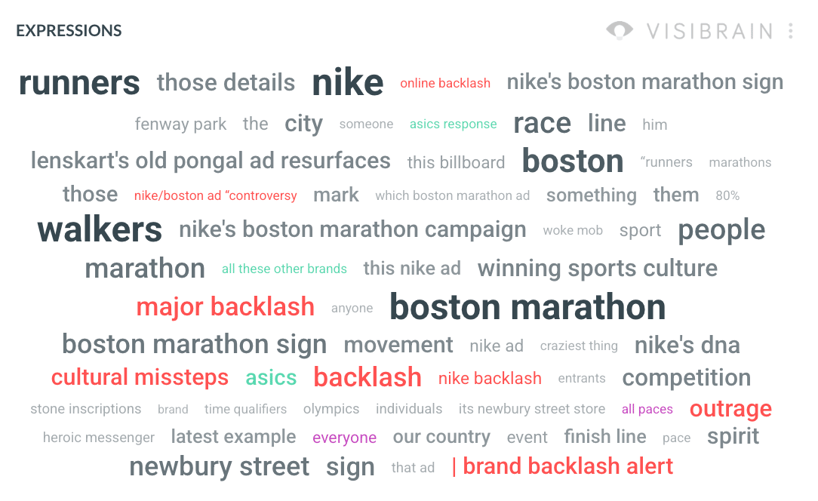
The term “backlash” clearly emerges as the dominant expression used to describe the controversy surrounding Nike during the peak of the crisis on social media. This is evident in the semantic cloud below, where the keyword, highlighted in orange, appears alongside other strong markers of the controversy such as “outrage”, “controversy” and “alert”.
At the same time, social media users have widely reinterpreted the campaign’s original message by contrasting it with values of inclusion and openness. Phrases such as “all paces” and “everyone” stand out, shown in purple in the cloud below, directly challenging what was perceived as Nike’s more elitist positioning.

Faced with a rapid surge of criticism across social platforms, Nike opted for a defensive response: first removing the billboard campaign, then issuing a press release. In it, the brand acknowledged it had “missed the mark” and reiterated its original intent—to make running accessible to all, “regardless of pace, experience or distance”.
Notably, however, no direct messaging was deployed on its own social media channels. Neither on its global accounts nor on its running-focused profiles did the brand publish any first-person statement or dedicated content addressing the controversy head-on for its community.
This approach reflects a deliberately restrained crisis management strategy. Nike allowed the conversation to evolve without re-engaging on the very platforms where it was gaining the most traction. The response relied on three primary levers: removal of the problematic campaign, institutional communication via the press, and indirect dissemination of its message through media outlets.
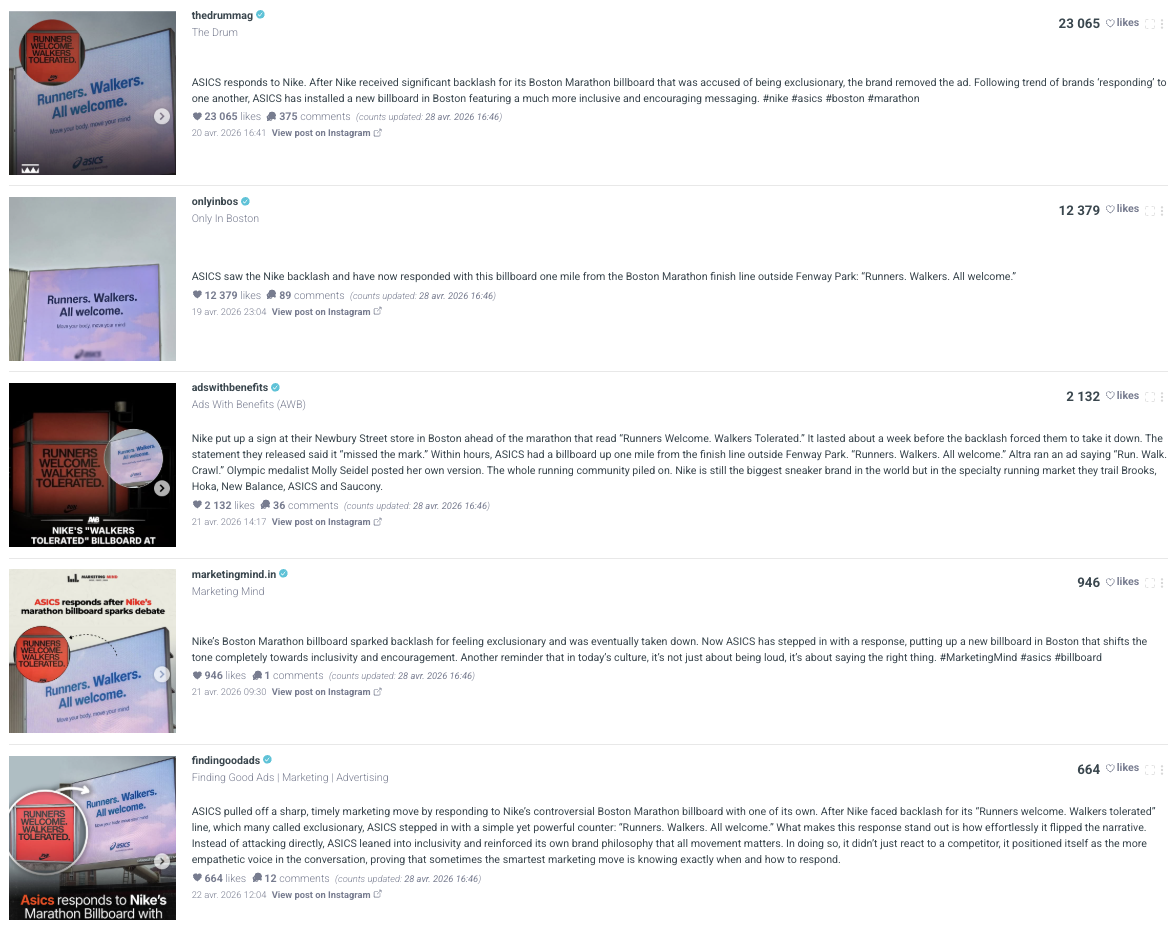
The campaign did not escape the responsiveness of competing brands such as ASICS, which chose to take the opposite stance with a simple, inclusive message: “Runners. Walkers. All welcome.”
A deliberate positioning, but without any dedicated digital rollout: ASICS did not communicate about this initiative on its own social media channels, relying solely on urban billboards.
Even so, the move did not go unnoticed. It was quickly picked up and amplified by users across social platforms, particularly on Instagram, where several posts, some exceeding 10,000 likes, highlighted the contrast with Nike’s campaign.
While major sporting figures remained relatively restrained, a number of runners and running experts reacted to the viral campaign in more direct terms. This is notably the case of Hussain Al-Zubaidi, a physician and runner known for his analysis of training, marathon culture, and inclusivity in running.
Very active on Instagram, he published several posts on the topic, totalling five dedicated publications. His first intervention in particular resonated strongly, generating more than 3,300 likes, around 16 times higher engagement than his account’s average performance.
Other female athletes also spoke out to criticise the campaign, including Robyn Michaud. In a strongly worded post, she shared her personal experience: “Seen this week in Boston. This is the fifth time I have qualified on time in the para-athletics category.”
She concluded her post, which accumulated 2,866 likes, with a direct message to Nike: “Thank you for TOLERATING me”, before adding that she is “proud to be part of the Brooks Running team”.
The message illustrates the perceived gap between the campaign’s intended positioning and the lived reality of parts of the running community, particularly para-athletes.
Beyond social media, Nike’s campaign quickly entered the international media agenda. Nearly 70% of the articles identified were published in English, compared with 16% in French and 6% in German, indicating a controversy largely driven by English-speaking markets.

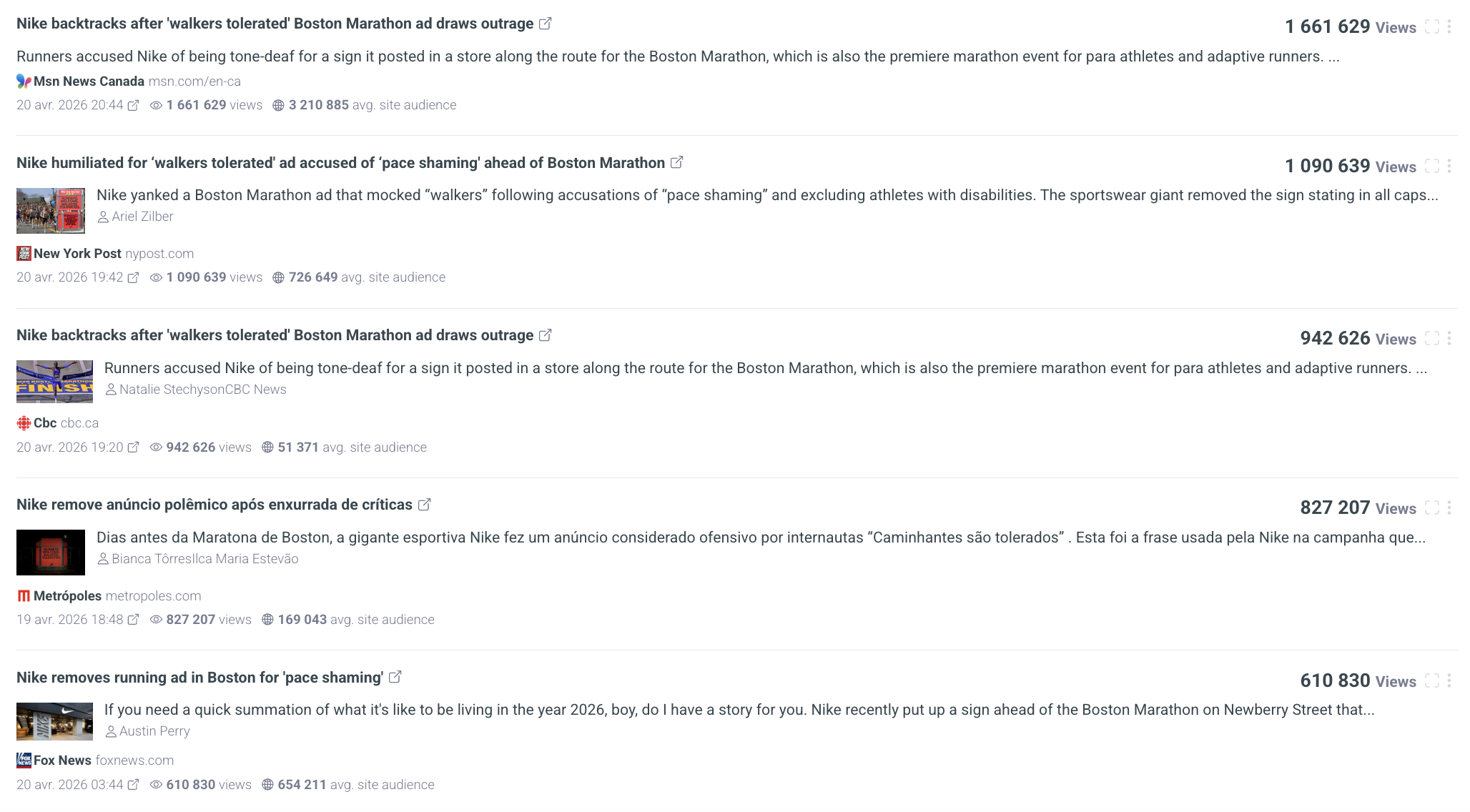
This coverage combines both generalist media and specialised publications, which relay the controversy and its developments. Some pieces reached particularly high audiences: an article published by MSN Canada exceeded 1.6 million views, while the New York Post described Nike as “humiliated” and accused it of “pace shaming”, generating over one million views.
Other publications also came close to this threshold, as shown in the selection below, confirming the scale of media virality surrounding this crisis.
Original article by Marie Guyomarc'h, adapted and translated by Sophie von Mensenkampff
Newsletter
.png?width=1090&height=1330&name=CTA%20newsletter%20(1).png)