Reputation Management
Effortlessly and accurately track the web and social network impact of your brand

Why Visibrain
Our Coverage
The best coverage across the web and social networks
Our Technology
Our intuitive interface uses cutting-edge technology
Our Support
Our team is with you every step of the way
Featured
5 Easy Steps to choose the Right Social Listening Tool

Learn more
Our clients
Brands
Visibrain for brands
Institutions & Local Authorities
Visibrain for institutions and local authorities
Agencies
Visibrain for agencies
Success Stories
Discover how our clients use Visibrain
Client stories
How LVMH is using LinkedIn monitoring to boost its influence with Visibrain

Read the case study
Resources
Blog
Stay up to date
White Papers
Studies, industry analysis and advanced insights
Case studies
Our client stories
Help center
Guides and resources for users
Newsletter
Stay up to date with the latest Visibrain news!
Webinars
Our upcoming webinars.
Our Last Study
Employee Advocacy Tracking Toolkit

Download the full guide
A fundamental shift has taken place on LinkedIn in recent years. Once viewed primarily as a professional networking platform, LinkedIn has evolved significantly through the diversification of communities, the rise of new content formats, the growing influence of expert voices, and increasing opinion polarisation. Today, the platform has established itself as a global channel for influence and thought leadership, while remaining the leading professional social network.
Within this new landscape, LinkedIn has become a major visibility channel for brands. Yet, for many organisations, it remains a strategic blind spot when it comes to social listening and media monitoring.
Employees play a central role in this ecosystem. Whether attending events and trade shows, sharing campaign launches, announcing promotions, or celebrating new partnerships and contracts, they regularly publish content on behalf of, or in connection with, their organisation, either independently or as part of coordinated advocacy initiatives. Alongside them, company leaders also play a key role, acting as public representatives of the business and contributing significantly to its visibility on the platform.
However, this growing activity introduces a new challenge. For most organisations, it has become virtually impossible to gain a comprehensive view of all employee and leadership communications on LinkedIn. As content becomes increasingly distributed across individual profiles, visibility is fragmented, making it difficult to measure, coordinate, and manage the organic conversation surrounding the brand.
Visibrain's LinkedIn monitoring capabilities, already used by organisations for several years, are evolving to offer a new approach to tracking activity on the platform.
The concept is straightforward and brand-centric: simply enter your company name into Visibrain to capture posts published by your employees and leadership teams on LinkedIn.
This comprehensive view is available in real time and covers all key stakeholders across the organisation, including employees, managers, executives, and members of the leadership team, regardless of their geographic location.
By bringing these conversations together in a single environment, organisations can build a complete, structured view of the content being shared around their brand. This provides deeper insight into employee and leadership advocacy, helping teams better understand their visibility, influence, and reach on LinkedIn.

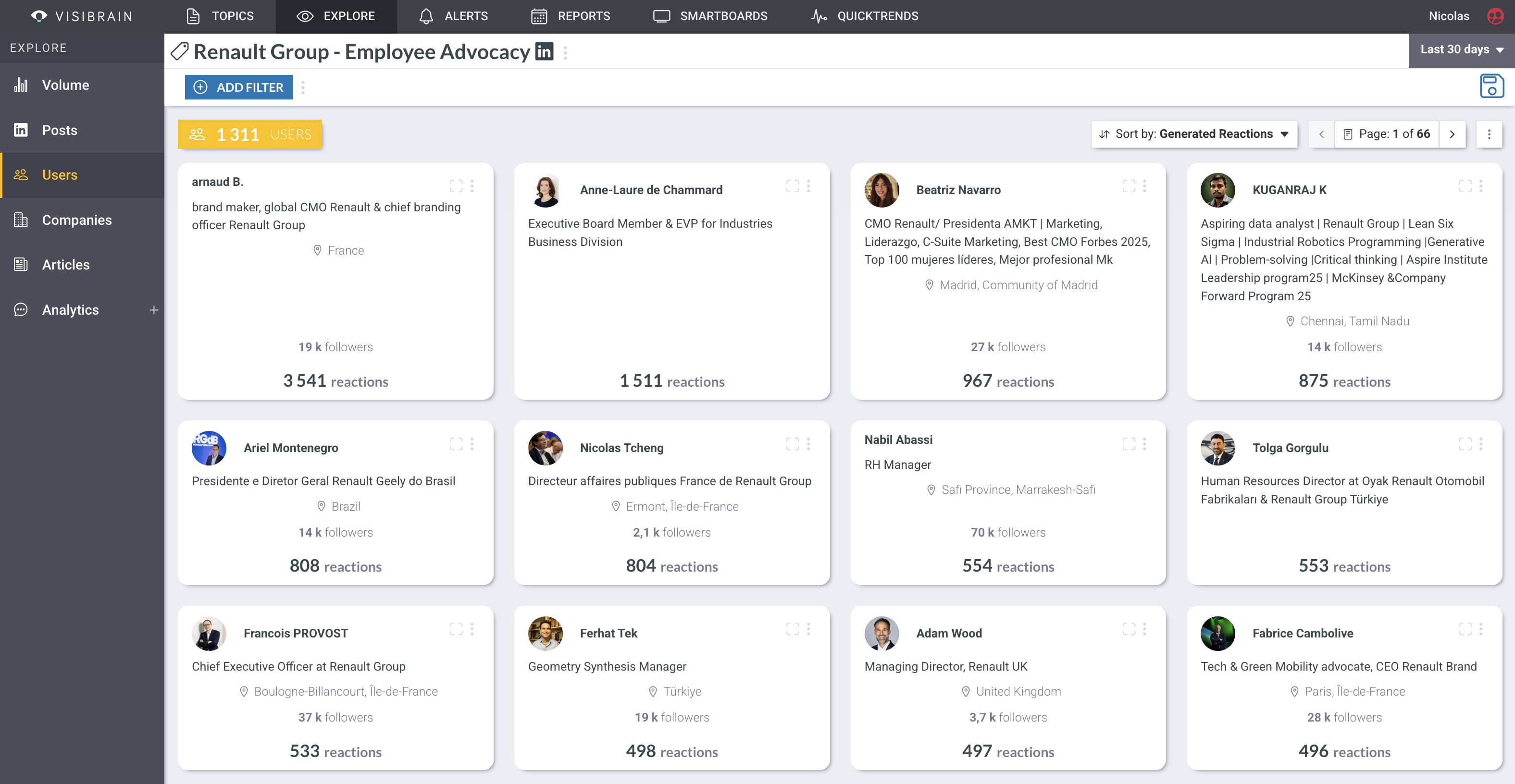
This new feature enables teams to identify their most impactful brand advocates and better understand the organic reach of employee and leadership communications. With Visibrain’s ranking and sorting capabilities, organisations can quickly pinpoint the employees who generate the highest levels of engagement, publish most frequently, or have the largest professional audiences.
The platform’s advanced filtering options also allow for more granular analysis. Teams can identify the most active or influential voices around specific topics by applying keyword filters such as "sustainability", "technology", or "employee wellbeing". This makes it easy to discover which individuals are driving conversations and shaping perceptions around strategic themes.
The example below showcases a monitoring dashboard focused on employees at Renault. Results can be analysed across any time period, providing a flexible view of advocacy activity and influence over time.
This new feature also strengthens competitive intelligence efforts by enabling organisations to monitor competitors through the LinkedIn activity of their employees and leadership teams.
The objective is to gain a deeper understanding of strategic initiatives, such as product launches, talent acquisition efforts, innovation projects, or business developments, through the voices of the people driving them. This approach often provides a more authentic and granular perspective than traditional corporate communications alone.
In addition, this form of monitoring can help uncover emerging trends and weak signals before they become widely visible. It also offers valuable insight into how competitors are organised, where their expertise lies, and which topics are generating momentum within their teams.
By bringing employee and leadership advocacy into the competitive intelligence process, Visibrain provides organisations with a powerful source of market insight, helping them refine their positioning, inform strategic decision-making, and stay ahead of industry developments.
As employee and executive voices become increasingly visible on social media, organisations face a growing range of reputational risks. A single post from an employee can attract significant public attention and, in some cases, trigger a wider brand crisis. One notable example involved Le Slip Français, which faced widespread criticism after images shared on social media showed employees participating in a blackface-themed event.
As a result, monitoring employee and leadership communications has become an important component of brand reputation management. This challenge is particularly significant for large organisations and even more so in highly regulated industries such as finance, healthcare, and energy, where communication compliance is a critical concern.
With Visibrain's new employee and leadership advocacy feature, organisations can quickly identify sensitive or potentially problematic content published by employees, track high-risk communications, and receive real-time alerts when issues emerge. This enables teams to take proactive action before a situation escalates across social media and beyond.
Reputation and compliance monitoring is no longer solely about crisis management. It has become a strategic discipline focused on prevention, governance, and the long-term protection of corporate reputation.
Original article by Marie Guyomarc'h, adapted and translated by Sophie von Mensenkampff
Newsletter
.png?width=1090&height=1330&name=CTA%20newsletter%20(1).png)