Reputation Management
Effortlessly and accurately track the web and social network impact of your brand

Why Visibrain
Our Coverage
The best coverage across the web and social networks
Our Technology
Our intuitive interface uses cutting-edge technology
Our Support
Our team is with you every step of the way
Featured
5 Easy Steps to choose the Right Social Listening Tool

Learn more
Our clients
Brands
Visibrain for brands
Institutions & Local Authorities
Visibrain for institutions and local authorities
Agencies
Visibrain for agencies
Success Stories
Discover how our clients use Visibrain
Client stories
How LVMH is using LinkedIn monitoring to boost its influence with Visibrain

Read the case study
Resources
Blog
Stay up to date
White Papers
Studies, industry analysis and advanced insights
Case studies
Our client stories
Help center
Guides and resources for users
Newsletter
Stay up to date with the latest Visibrain news!
Webinars
Our upcoming webinars.
Our Last Study
PR Crises in the AI Era

Download the full guide

The conversation around Novig and Sydney Sweeney grew rapidly over the seven-day period. Between September 10 and September 17, we recorded:
The scale of the conversation increased particularly quickly from September 14 onwards. Before this point, daily mentions remained below 20,000 posts. On September 16, the conversation reached a peak of more than 400,000 tweets and retweets in a single day.
Retweets also accounted for 66% of the total conversation, with 678,765 retweets compared with 355,772 original posts.This shows how quickly the campaign moved beyond its initial audience once the controversy began gaining traction.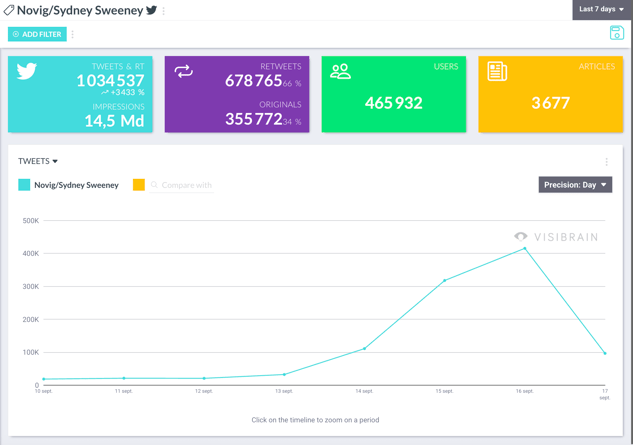

The scale of the conversation was not the only notable development. The sentiment surrounding the campaign was also divided: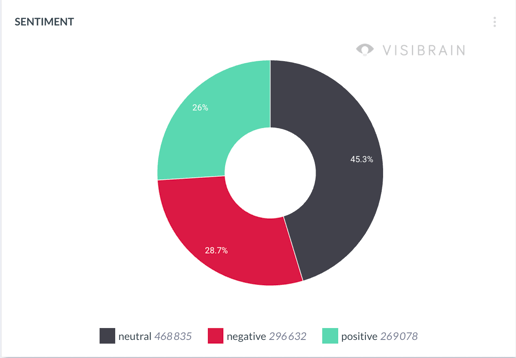
Negative mentions accounted for 28.7% of the conversation, compared with 26% positive mentions. The difference was relatively small, but the negative conversation became particularly visible as athletes and commentators began criticising the campaign's portrayal of women in sport.
Among the voices discussing the campaign were Olympic athletes including Ariarne Titmus, Amy Hunt and Sophie Capewell. Their involvement helped bring the conversation beyond sports betting audiences and into a wider discussion about the representation of women in sport.
The hashtags surrounding the campaign show just how far the conversation moved from Novig's original positioning. Hashtags including #womeninsport and #womeninsports became prominent as athletes and other users shared content about women's participation in sport. Some posts directly contrasted the campaign's imagery with footage of women competing, using the discussion to make a broader point about how female athletes are represented online.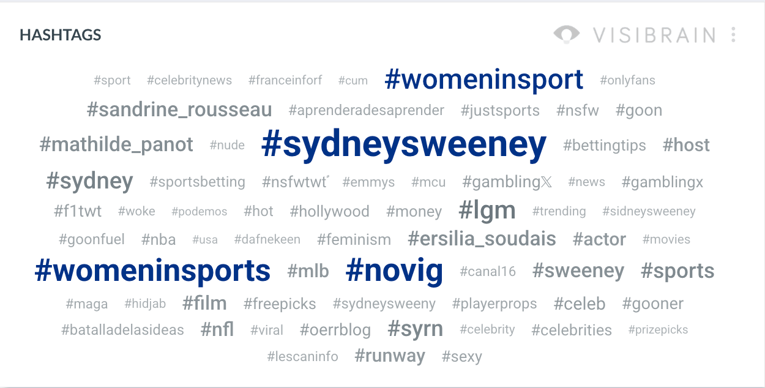
The conversation also spread into political and cultural discussions, with hashtags relating to feminism, “woke” politics and MAGA appearing alongside the campaign. This created a very different online context from the one originally associated with Novig's sports betting proposition
Looking at the most widely shared posts reveals two distinct sides of the debate.
One of the most widely shared posts criticised the campaign and its impact on the representation of women:
Other high-performing posts took the opposite position, defending Sweeney and criticising the media coverage surrounding the campaign. One post from @EndWokeness generated more than 15,000 retweets, alongside over 105,000 likes and more than 6,500 replies.

The Novig campaign shows how quickly a brand conversation can evolve once it connects with an existing cultural debate. What started as a sports betting campaign became a conversation about women in sport, feminism, politics and sexualisation, attracting audiences well beyond Novig's core category.
For communications teams, this is where social listening can provide a useful view of a developing controversy. Tracking the volume of mentions shows how big the conversation has become, while sentiment, hashtags and the accounts driving the discussion help explain why it is spreading.
In this case, the most important development was not simply the number of people talking about Novig. It was the way the conversation changed as new communities entered the discussion.
Newsletter
.png?width=1090&height=1330&name=CTA%20newsletter%20(1).png)