Reputation Management
Effortlessly and accurately track the web and social network impact of your brand

Why Visibrain
Our Coverage
The best coverage across the web and social networks
Our Technology
Our intuitive interface uses cutting-edge technology
Our Support
Our team is with you every step of the way
Featured
5 Easy Steps to choose the Right Social Listening Tool

Learn more
Our clients
Brands
Visibrain for brands
Institutions & Local Authorities
Visibrain for institutions and local authorities
Agencies
Visibrain for agencies
Success Stories
Discover how our clients use Visibrain
Client stories
How LVMH is using LinkedIn monitoring to boost its influence with Visibrain

Read the case study
Resources
Blog
Stay up to date
White Papers
Studies, industry analysis and advanced insights
Case studies
Our client stories
Help center
Guides and resources for users
Newsletter
Stay up to date with the latest Visibrain news!
Webinars
Our upcoming webinars.
Our Last Study
PR Crises in the AI Era

Download the full guide

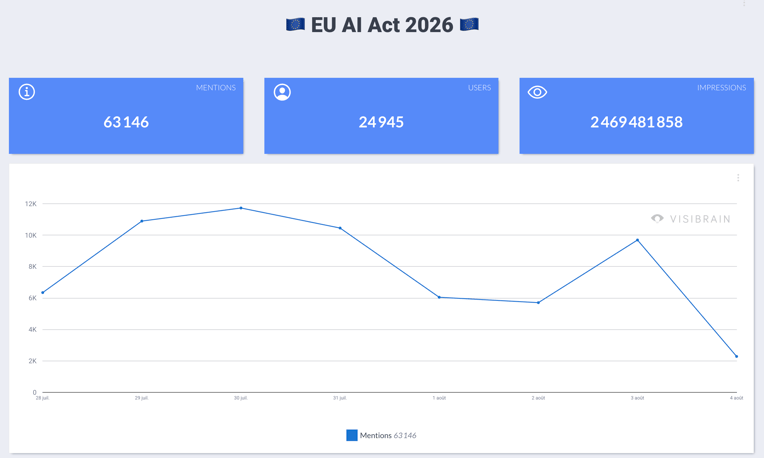
The AI Act generated more than 63,000 online mentions from nearly 25,000 users between 28 July and 4 August, reaching over 246 million impressions. Rather than peaking on the day the legislation came into force, the conversation reached its highest point on 30 July, with almost 12,000 mentions as businesses, journalists and policymakers prepared for the upcoming deadline.
A second surge followed on 3 August, after the new provisions officially took effect. This two-stage pattern illustrates how major regulatory developments often generate discussion both before implementation, and afterwards, as the implications begin to be interpreted and shared more widely.

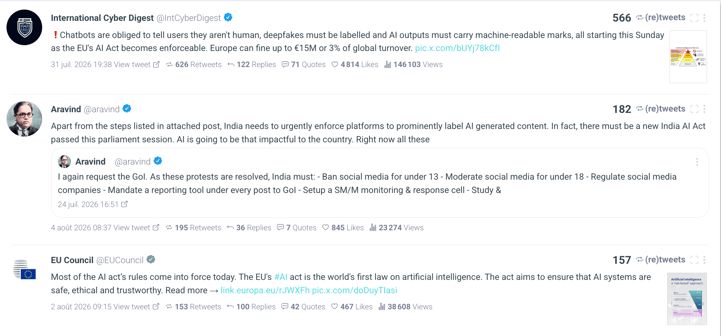
The most widely shared posts focused less on the legal wording of the AI Act and more on its practical implications. Explanations of new transparency requirements, including the obligation to label certain AI-generated content and deepfakes, attracted some of the highest engagement across the platform.
The conversation also extended well beyond Europe. Alongside updates from EU institutions, commentators from countries including India referenced the legislation as a model for future AI governance. This demonstrates how the AI Act is increasingly influencing global discussions around responsible AI, even outside the European Union.
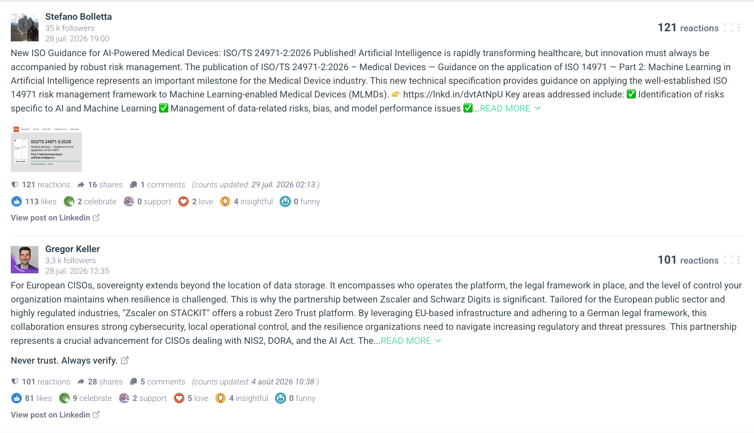
While X was dominated by news and policy updates, LinkedIn became a hub for professional analysis. Many of the highest-performing posts explored how the AI Act intersects with cybersecurity, healthcare, enterprise governance and industry standards, reflecting the practical challenges organisations now face.
This difference highlights the complementary role of each platform. X captured immediate public reaction to the legislation, while LinkedIn hosted longer-form conversations focused on implementation, compliance and business strategy. Together, they provide a more complete picture of how different audiences are engaging with the AI Act.
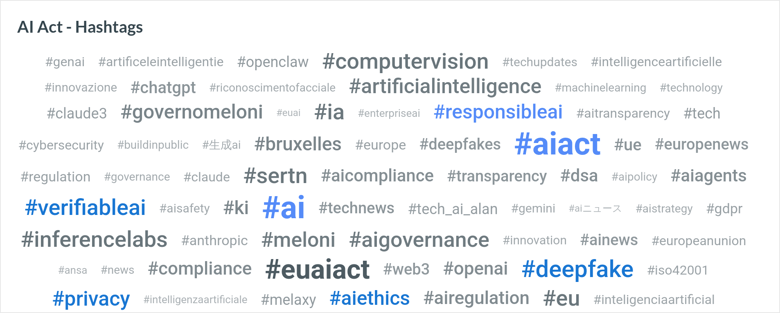
The hashtag cloud reveals that transparency has emerged as one of the defining themes of the conversation. Alongside broader terms such as #AI, #AIAct and #EUAIAct, hashtags including #ResponsibleAI, #Deepfake, #Privacy, #Compliance and #AIGovernance feature prominently, suggesting that discussions are centred on trust and accountability rather than legislation alone.
These themes reinforce a broader shift in the AI conversation. As organisations adopt AI more widely, regulatory compliance is becoming closely linked with public perception. Businesses are no longer expected to simply use AI responsibly, they are increasingly expected to communicate clearly about how AI is used, where it is deployed and how AI-generated content is disclosed.
The first week of conversation around the EU AI Act shows that AI regulation is no longer confined to legal teams or policymakers. From transparency and deepfakes to responsible AI and public trust, the discussion has become a mainstream conversation that spans industries and borders.
As organisations continue to integrate AI into their products and communications, monitoring these conversations will be just as important as monitoring the legislation itself. Social listening provides businesses with an early view of emerging concerns, shifting expectations and the narratives that will shape AI adoption in the months ahead.
respond effectively.
Newsletter
.png?width=1090&height=1330&name=CTA%20newsletter%20(1).png)