Reputation Management
Effortlessly and accurately track the web and social network impact of your brand

Why Visibrain
Our Coverage
The best coverage across the web and social networks
Our Technology
Our intuitive interface uses cutting-edge technology
Our Support
Our team is with you every step of the way
Featured
5 Easy Steps to choose the Right Social Listening Tool

Learn more
Our clients
Brands
Visibrain for brands
Institutions & Local Authorities
Visibrain for institutions and local authorities
Agencies
Visibrain for agencies
Success Stories
Discover how our clients use Visibrain
Client stories
How LVMH is using LinkedIn monitoring to boost its influence with Visibrain

Read the case study
Resources
Blog
Stay up to date
White Papers
Studies, industry analysis and advanced insights
Case studies
Our client stories
Help center
Guides and resources for users
Newsletter
Stay up to date with the latest Visibrain news!
Webinars
Our upcoming webinars.
Our Last Study
PR Crises in the AI Era

Download the full guide

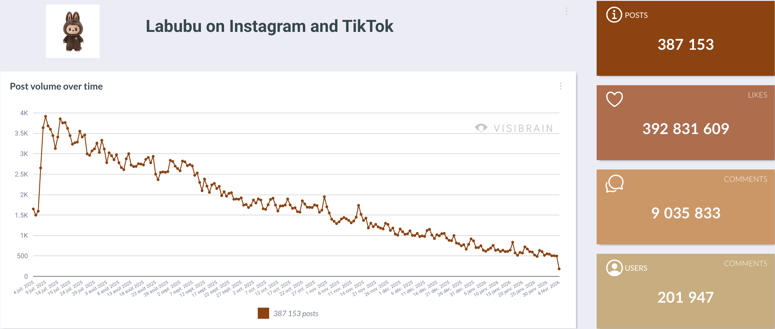
Our six-month overview shows the defining moment of the Labubu trend: a sharp spike in conversation during the summer, followed by a gradual decline. In total, the period generated:
This level of engagement signals more than passing interest — it reflects a moment when Labubu crossed from collector circles into mainstream visibility.
A major driver of this phase was celebrity and entertainment culture. One standout Instagram post from Entertainment Tonight spotlighted the upcoming Labubu movie, showcasing celebrity endorsements including Hailey Bieber, Mariah Carey, and tennis player Naomi Osaka, whose “Billie Jean Bling” Labubu helped position the character as a lifestyle and fashion-adjacent object rather than just a toy.
Insight: Celebrity influence functions as a legitimisation engine, rapidly expanding a niche product into mainstream awareness.
After the initial celebrity-fuelled surge, conversation did not immediately collapse. Instead, mentions stabilised, driven by a different kind of content: rare finds, unboxings, and collector victories.
This phase illustrates how Labubu’s business model helped sustain attention. Blind-box mechanics transform purchasing into a game of probability, where the emotional payoff lies in the possibility of rarity. Each unboxing becomes shareable content, turning individual consumption into collective entertainment.
The product itself becomes secondary to the moment of reveal. Social engagement is driven by suspense, surprise, and social proof — the digital equivalent of a jackpot moment.
Insight: Once awareness is established, gamified scarcity can prolong a trend, shifting motivation from admiration to participation.

From autumn onward, the data shows a steady decline in mention volume. This is not a sudden disappearance, but a gradual cooling — often a sign of cultural fatigue.
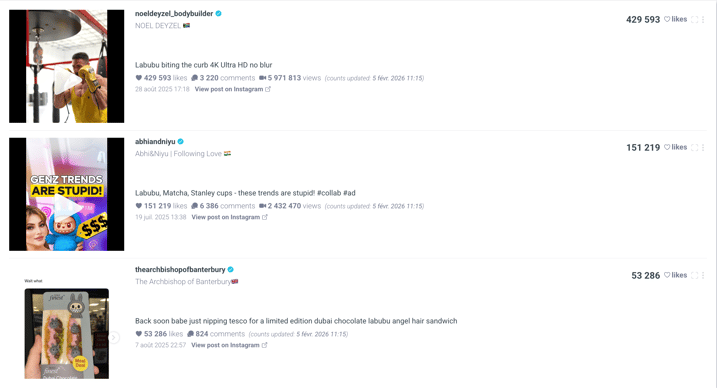
Top Instagram posts with negative sentiment reveal a shift in tone. Some users began describing the trend as “stupid,” while meme accounts mocked the perceived absurdity of limited-edition culture. One viral example joked:
“Back soon babe just nipping Tesco for a limited edition Dubai chocolate Labubu angel hair sandwich.”
Humour becomes a vehicle for criticism, reframing Labubu from desirable to excessive. As resale prices, scarcity tactics, and constant drops dominate the conversation, enthusiasm gives way to scepticism.
This is a common turning point in hype cycles. The same mechanics that drive desire, exclusivity and artificial scarcity, can begin to feel exploitative once novelty fades.
Insight: Trends built on engineered scarcity carry a sentiment tipping point, where excitement turns into irony or resistance.
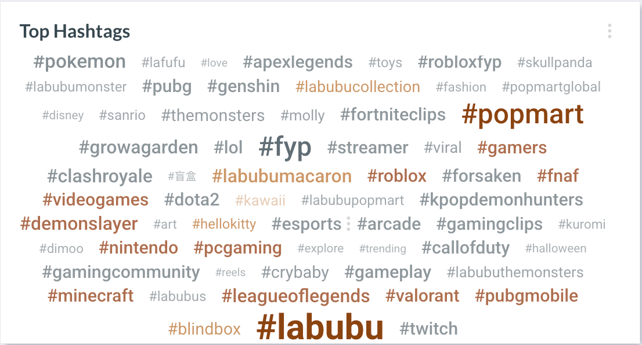
One of the most unexpected findings from the hashtag analysis was the strong presence of gaming-related communities. Hashtags linked to Roblox, Minecraft, Five Nights at Freddy’s (FNAF), and more appeared frequently alongside Labubu content.
This crossover highlights how gaming spaces now function as major engagement ecosystems for brands. These communities are visually driven, avatar-oriented, and heavily invested in digital collectibles and character culture, making them a natural environment for a figure like Labubu to thrive.
Insight: Gaming culture has become a powerful amplification layer for physical products, especially those that resemble characters or skins rather than traditional consumer goods.
Labubu’s social media trajectory illustrates a repeatable three-stage pattern in the attention economy:
The trend does not disappear entirely, it transitions from mainstream obsession to niche collector culture. For brands, the lesson is not simply how to go viral, but how to recognise where they are in the hype cycle, and when the mechanics driving growth may begin to erode sentiment. Labubu shows that in today’s digital landscape, virality is rarely accidental. It is engineered, amplified, and eventually tested by the very audiences that once propelled it.
Newsletter
.png?width=1090&height=1330&name=CTA%20newsletter%20(1).png)