Reputation Management
Effortlessly and accurately track the web and social network impact of your brand

Why Visibrain
Our Coverage
The best coverage across the web and social networks
Our Technology
Our intuitive interface uses cutting-edge technology
Our Support
Our team is with you every step of the way
Featured
5 Easy Steps to choose the Right Social Listening Tool

Learn more
Our clients
Brands
Visibrain for brands
Institutions & Local Authorities
Visibrain for institutions and local authorities
Agencies
Visibrain for agencies
Success Stories
Discover how our clients use Visibrain
Client stories
How LVMH is using LinkedIn monitoring to boost its influence with Visibrain
Read the case study
Resources
Blog
Stay up to date
White Papers
Studies, industry analysis and advanced insights
Case studies
Our client stories
Help center
Guides and resources for users
Newsletter
Stay up to date with the latest Visibrain news!
Webinars
Our upcoming webinars.
Our Last Study
Employee Advocacy Tracking Toolkit

Download the full guide
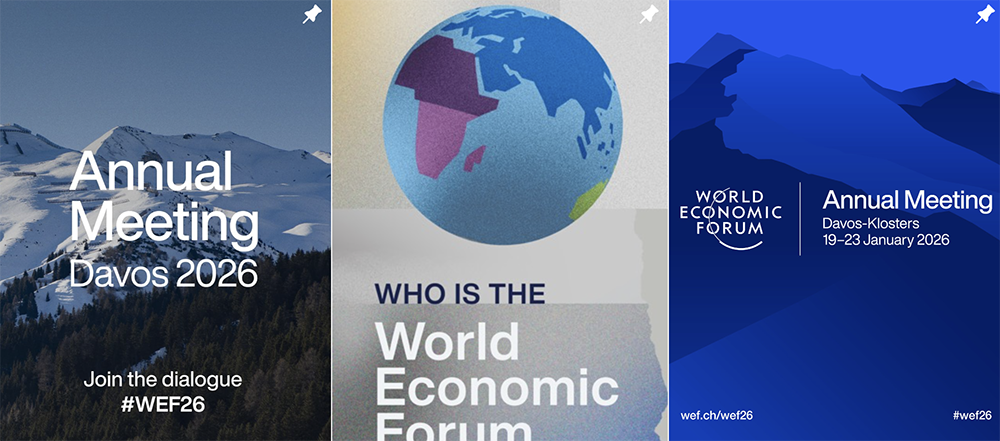
Since the start of the event, the World Economic Forum has quite literally set X alight, generating more than 3.5 million posts, an average of over 875,300 messages per day. This wave of conversation far exceeds the previous edition: mentions are three times higher this year than in 2025, confirming unprecedented interest in Davos.
Another point of comparison: the 2026 edition has generated 3.5 times more discussion than another major international benchmark event, COP30.
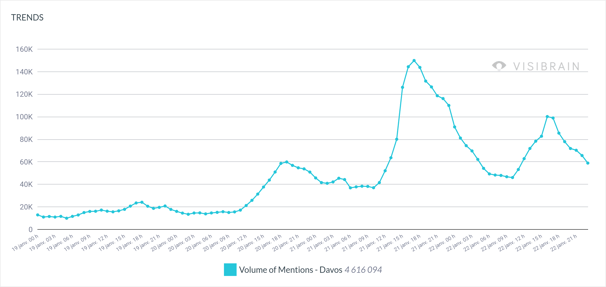
Unquestionably, the 56th edition of the World Economic Forum stands out as the most discussed on social media in recent years, as illustrated by the chart below. Between 2022 and 2025, the volume of mentions for each edition generally hovered around 1.5 million posts, with a slight peak in 2024 (2 million messages), largely driven by the widely followed address from Volodymyr Zelensky.
The 2026 edition, however, far surpasses these previous levels. With 4.6 million posts published in just four days, it has firmly established itself as one of the defining topics of the moment across social platforms. Several key moments and high-profile appearances, from political speeches to major economic debates, fuelled online discussions, resulting in exceptional visibility and extensive media coverage.
This momentum clearly shows how Davos 2026 is no longer confined to the walls of the summit itself, but now extends across the entire digital ecosystem, energising social networks on a global scale.
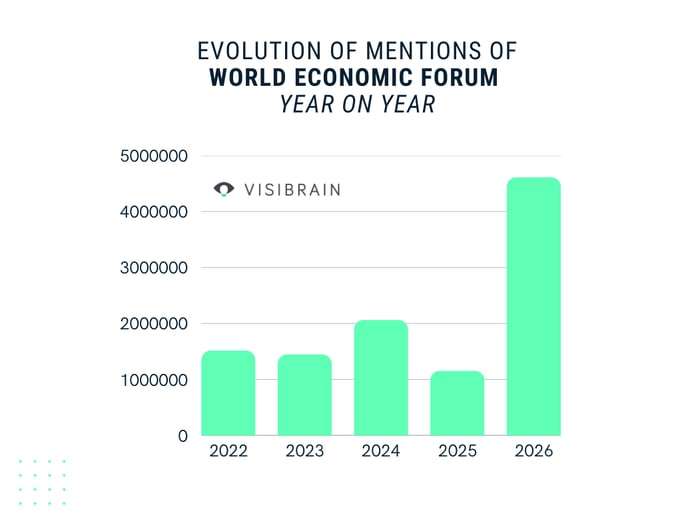

Among the standout moments of the 2026 edition, Donald Trump clearly dominated conversations on social media. His appearances significantly boosted the Forum’s visibility, accounting for 1.2 million posts.
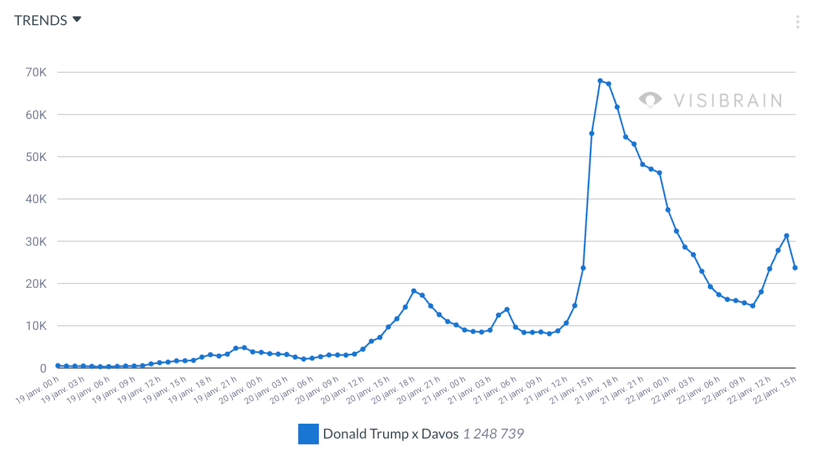
On 21 January, the day of one of his speeches, activity reached its most intense peak of the event: at 5 p.m., more than 67,000 posts were published in a single hour, the equivalent of 1,133 messages per minute. A true digital tidal wave that highlights the scale of his impact on online conversations, as shown in the timeline above.
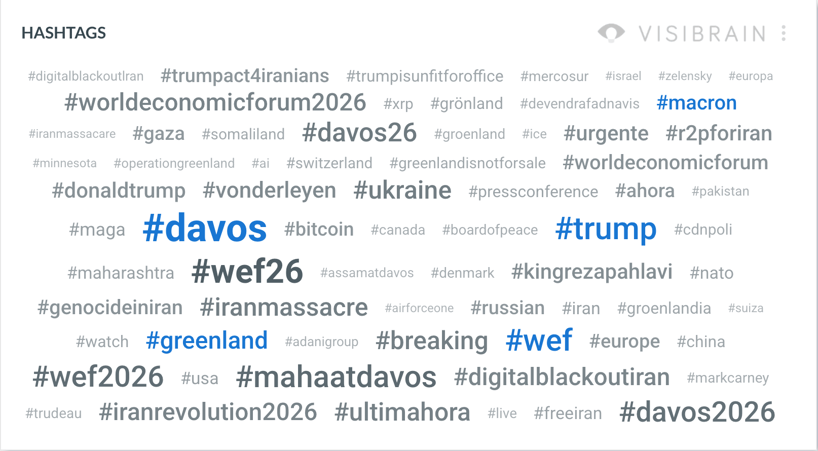
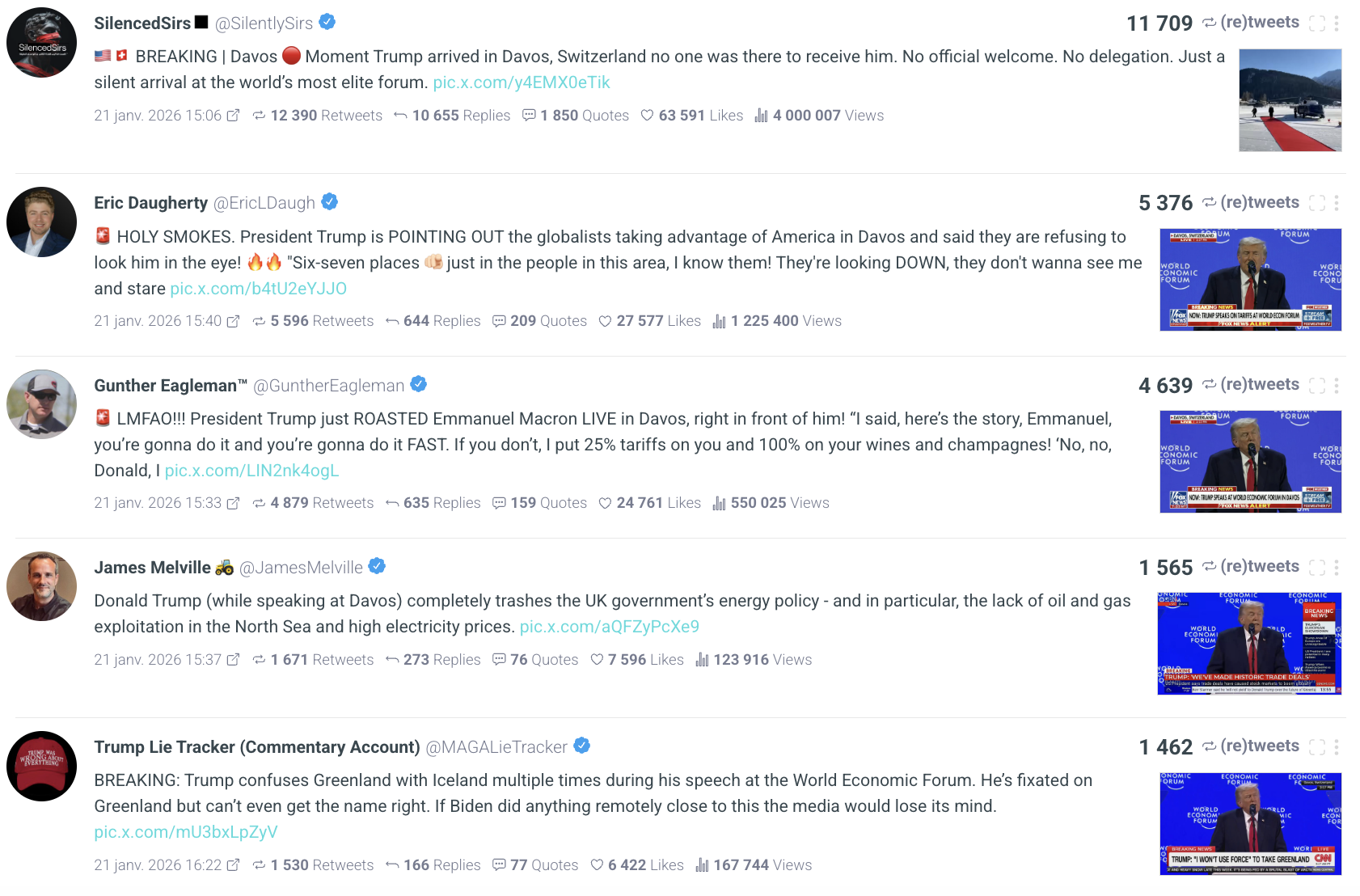
Among the most discussed topics surrounding him were his low-key arrival, his threats to impose tariffs on French wines and champagne directed at Emmanuel Macron, the Greenland issue, his remarks about the British government, and his stance on Chinese wind turbines.
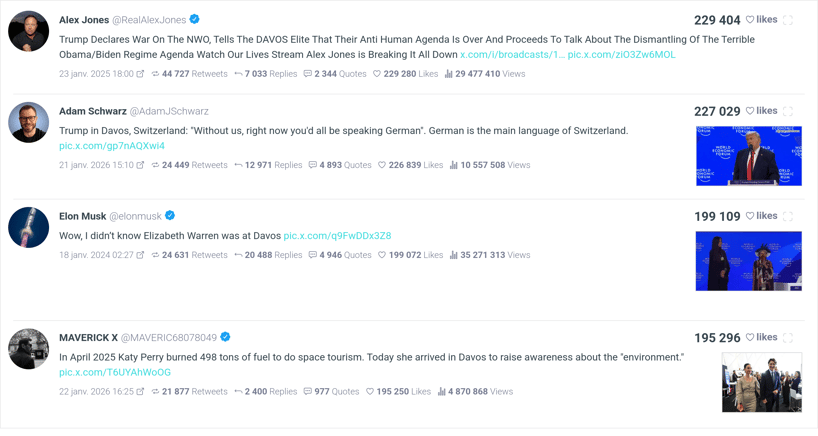
One of the most widely shared posts during the event came from the account @RealAlexJones, whose reaction to Donald Trump’s presence in Davos generated exceptional engagement. Framed in highly confrontational and dramatic terms, the post portrayed the former US president’s intervention as a direct challenge to global elites, echoing narratives that already resonate strongly within certain online communities. This type of polarising, emotionally charged content tends to travel fast on X, particularly when tied to a high-profile international event.
In parallel, other viral posts targeted public figures also present at the Forum, including criticism aimed at Katy Perry, with users highlighting the perceived contradiction between her environmental advocacy and her past participation in a space tourism flight. Together, these posts illustrate how opinion-driven and provocative takes on both political leaders and celebrities helped amplify the World Economic Forum’s visibility across social platforms.
Unlike on X, discussions around the event on LinkedIn follow a completely different editorial line. Controversial topics and political tensions, as well as personal exchanges and punchlines between public figures, receive very little attention. Instead, the focus is on corporate communications from participating companies, enthusiastic speeches by political figures, and the excitement of attendees sharing their event experiences.
Some political leaders, such as Christine Lagarde and Emmanuel Macron, use this platform to share their excitement about the Forum’s opening. The President of the European Central Bank posts a video saying, “Hello from Davos! I’m here for the annual meetings of the World Economic Forum. I’m looking forward to constructive dialogue and the exchange of views on the global economy,” which receives 2,578 reactions.
Meanwhile, Emmanuel Macron shares his “to-do list,” focused on supporting French businesses present in Davos, which gains 1,325 reactions.

In total, more than 630 companies shared content about the Forum on LinkedIn. These include consulting firms, audit firms, electrical companies, pharmaceutical groups, industrial companies, and communication agencies.
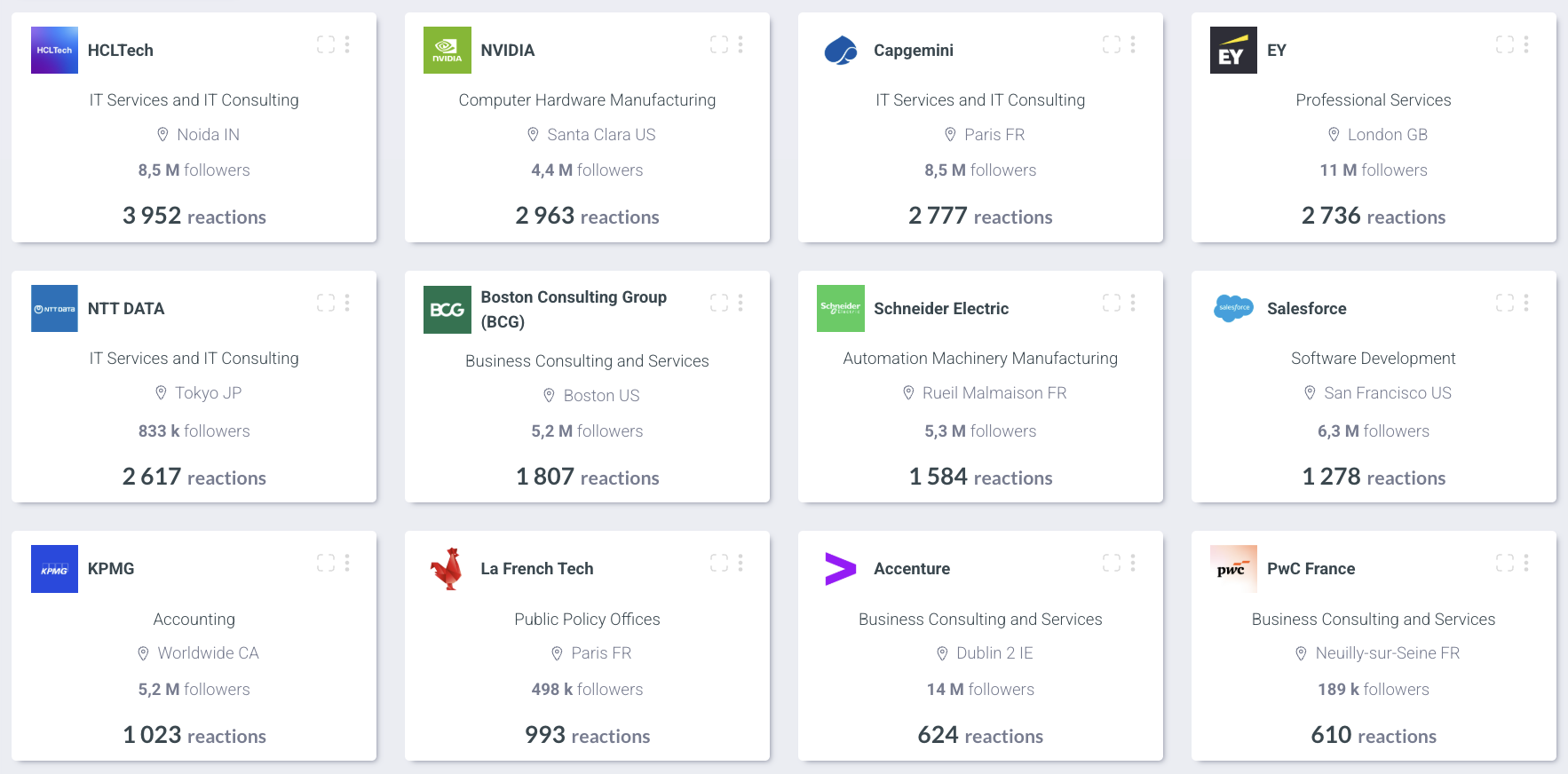
Among the most influential companies, HCLTech, NVIDIA and Capgemini stand out, occupying the top three in terms of reactions generated. They are followed by EY (2,736 reactions), NTT Data (2,617 reactions), and Boston Consulting Group (1,807 reactions), rounding out the top five.
Other notable players also feature in the top 12, including Schneider Electric (1,584 reactions), Salesforce (1,278 reactions), KPMG (1,023 reactions), La French Tech (993 reactions), Accenture (624 reactions), and PwC France (610 reactions).
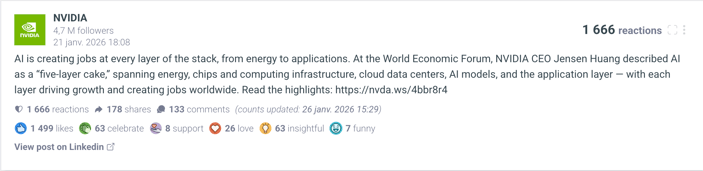
Some companies, such as NVIDIA, seized the opportunity presented by Davos to fully activate their presence on LinkedIn. By highlighting their CEO Jensen Huang's discussion at the event, they generated the most engagement of all companies across LinkedIn, with 1,666 reactions.
Meanwhile, EY takes an educational approach by posting on LinkedIn a mini dictionary of tech terms to know in 2026, accompanied by: “As business, government, and civil society leaders gather in Davos for the Annual World Economic Forum, this dictionary of technological disruptions is a must-read to stay informed.” The post received 1,562 reactions.
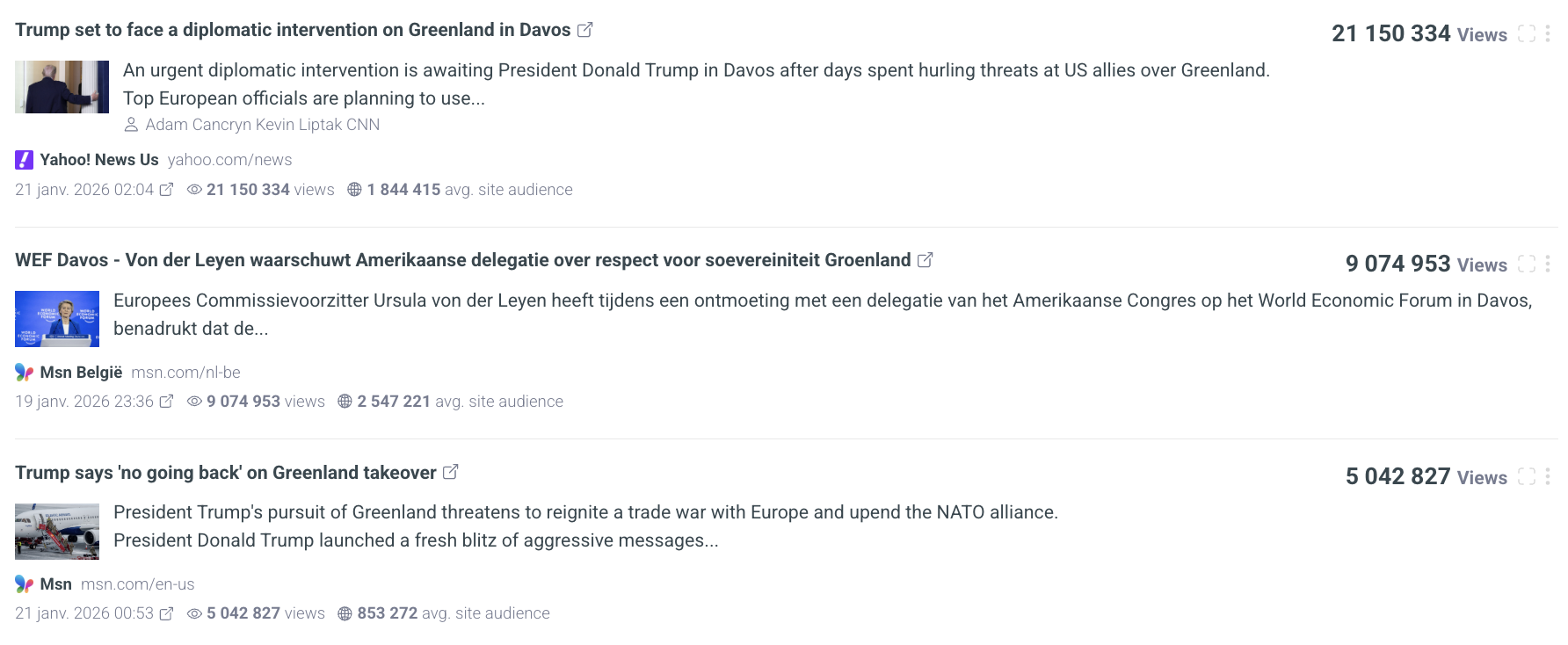
Traditional media also widely covered the event, with over 91,800 articles shared on social media. International coverage was dominated by English, which accounted for 56% of posts, followed by German (9%) and Italian (7%).
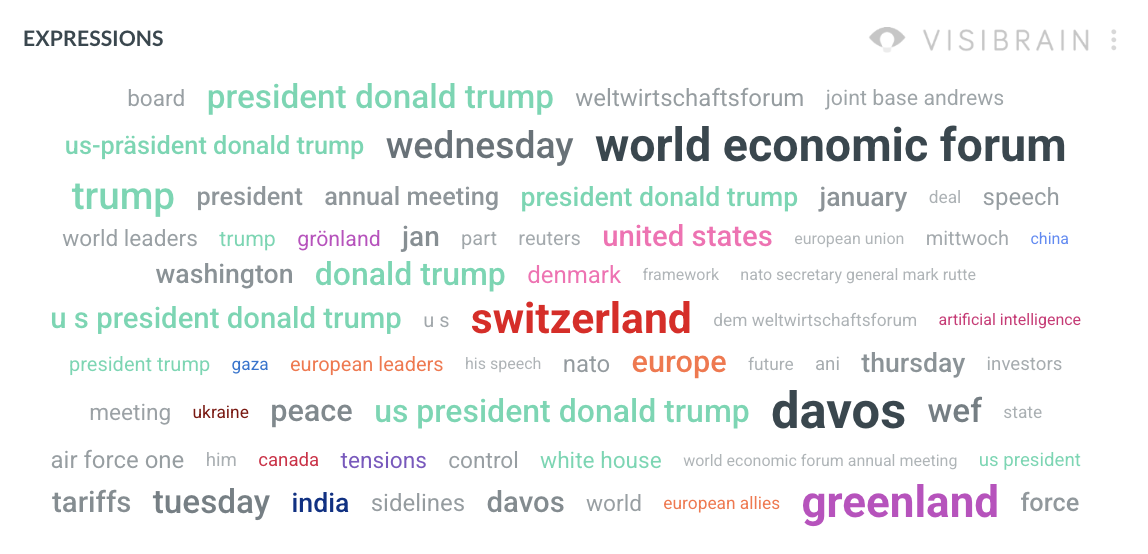
In the vast majority of cases, the articles focused on a key topic: Donald Trump, who features prominently in the most-used expression cloud (in green). The issue of Greenland, closely linked to his positions, also emerges notably in media coverage (in purple).
By contrast, other topics central to Davos received far less attention in the press: artificial intelligence (in pink) and international conflicts, whether in Gaza (in blue) or Ukraine (in burgundy), occupy only a marginal place in the shared articles.
Original article by Marie Guyomarc’h, adapted and translated by Sophie von Mensenkampff
Newsletter
.png?width=1090&height=1330&name=CTA%20newsletter%20(1).png)