Reputation Management
Effortlessly and accurately track the web and social network impact of your brand

Why Visibrain
Our Coverage
The best coverage across the web and social networks
Our Technology
Our intuitive interface uses cutting-edge technology
Our Support
Our team is with you every step of the way
Featured
5 Easy Steps to choose the Right Social Listening Tool

Learn more
Our clients
Brands
Visibrain for brands
Institutions & Local Authorities
Visibrain for institutions and local authorities
Agencies
Visibrain for agencies
Success Stories
Discover how our clients use Visibrain
Client stories
How LVMH is using LinkedIn monitoring to boost its influence with Visibrain

Read the case study
Resources
Blog
Stay up to date
White Papers
Studies, industry analysis and advanced insights
Case studies
Our client stories
Help center
Guides and resources for users
Newsletter
Stay up to date with the latest Visibrain news!
Webinars
Our upcoming webinars.
Our Last Study
Employee Advocacy Tracking Toolkit

Download the full guide
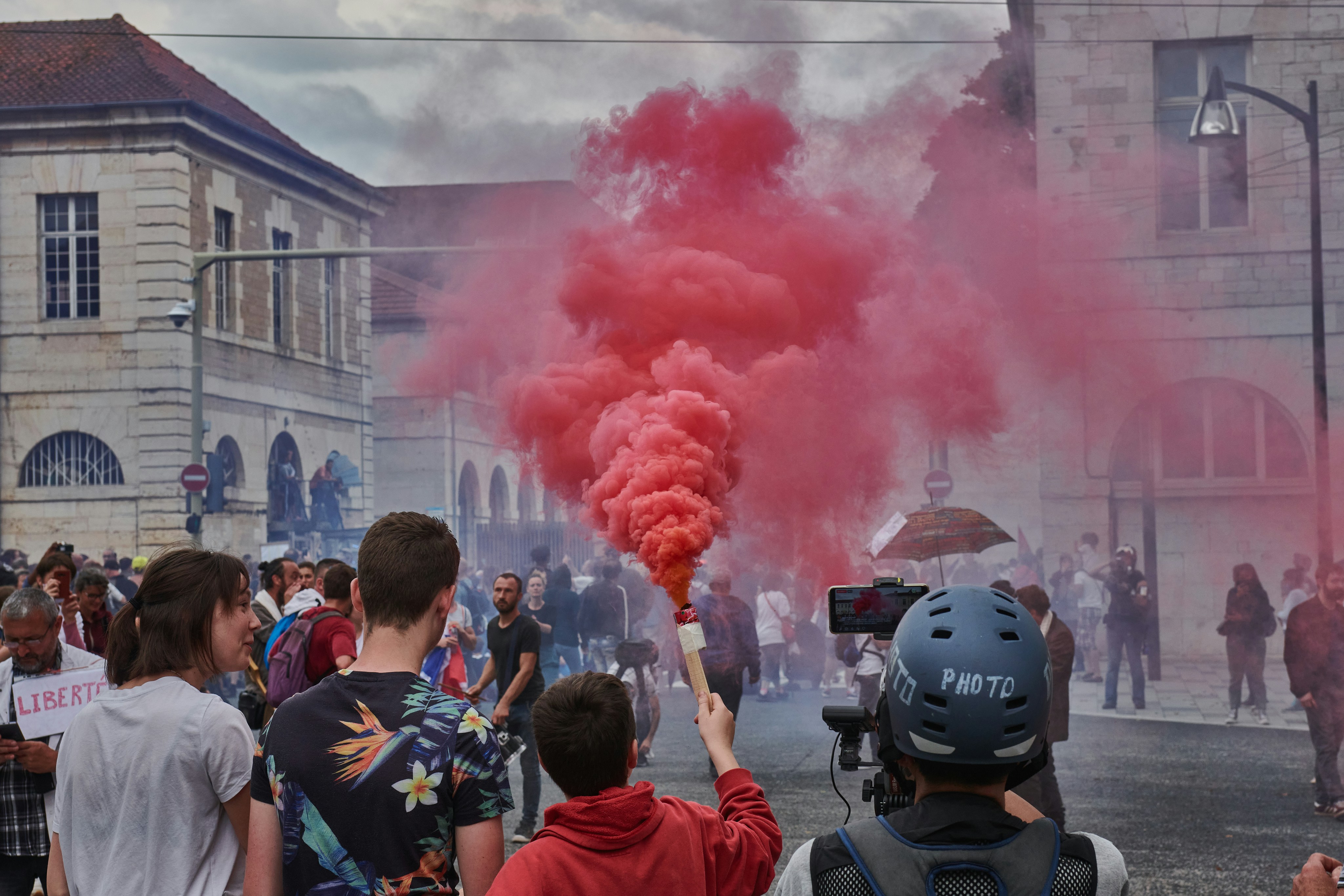
The scale of the conversation in France is already significant with millions of messages in French mentioning the high-school protests, highlighting the extent to which the student mobilisation has captured attention across the country.
At the same time, messages mentioning the 17 October have been consistently building over the past month. This date was already a major focus of the domestic conversation before the recent student mobilisation began to add another dimension to the planned demonstrations. Together, the figures show that the high-school protests are unfolding within a much larger period of mobilisation. What began around education is now part of a wider conversation encompassing political and economic dissatisfaction, with different groups preparing to take to the streets.
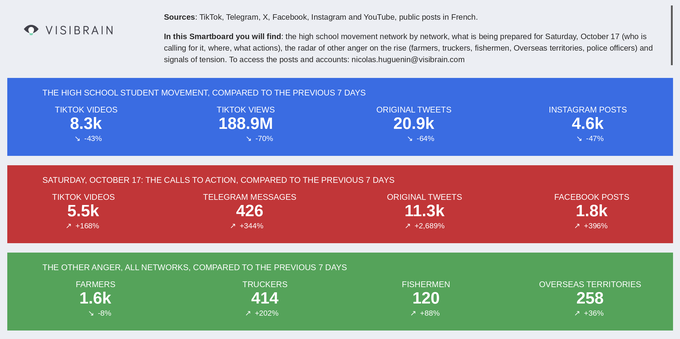

The shift is also visible in the groups appearing alongside the student movement. Over the past seven days, conversations involving truckers increased 202% to 414 messages, while discussion around fishermen rose 88% to 120. Mentions from France's overseas territories increased 36% to 258. Farmers remain the most prominent of these groups, with around 1,600 messages, although this represents an 8% decline compared with the previous week.

Together, these figures point towards a protest landscape that is becoming more diverse. The high-school movement may have captured significant attention, but the conversation around 17 October now extends well beyond education. Farmers, truckers, fishermen and overseas territories are all appearing within a broader discussion around mobilisation and anger in France.
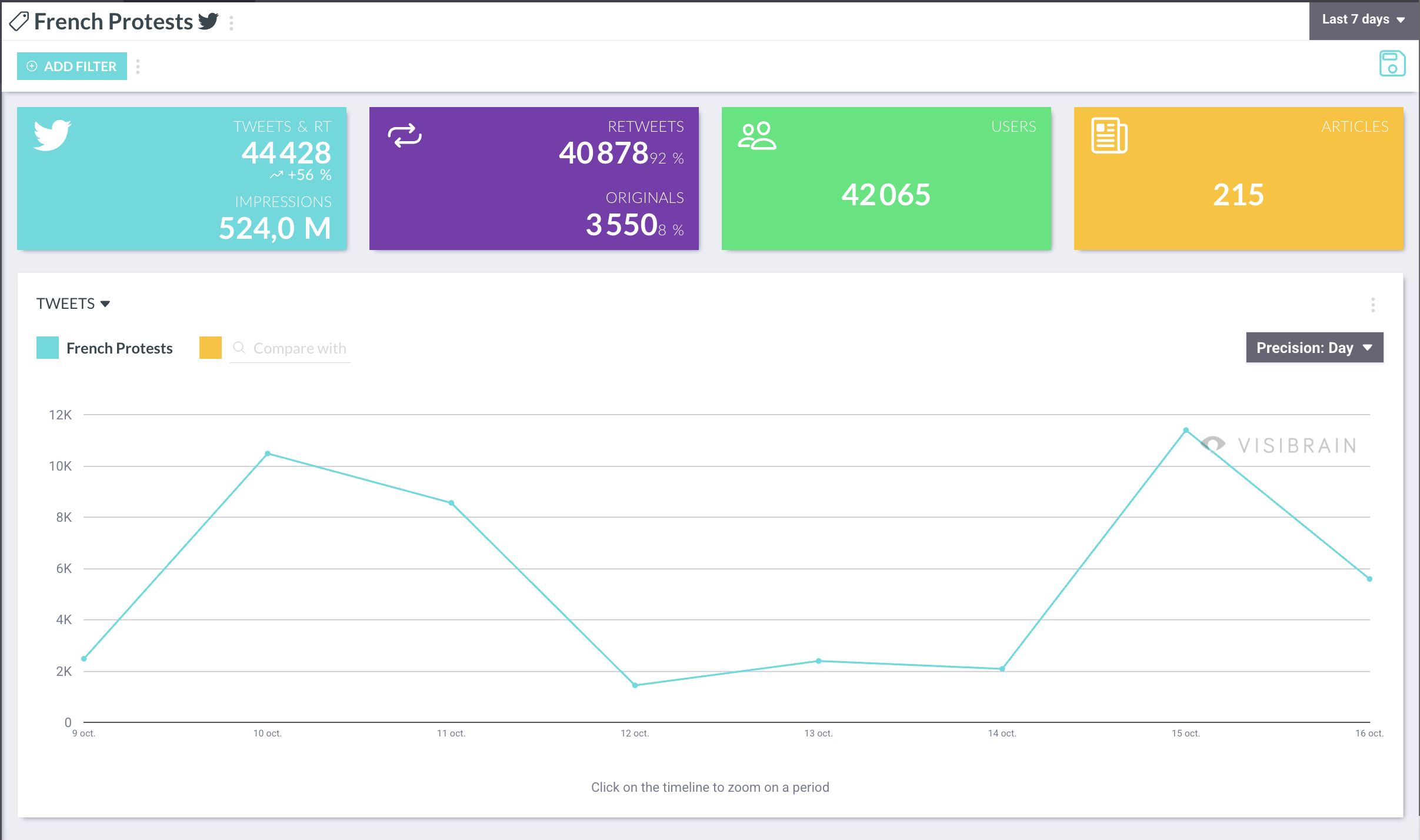
This increasingly complex situation is also attracting attention internationally. Over the past seven days, almost 45,000 mentions from more than 42,000 English-speaking users have discussed France's protests across X, Instagram and TikTok.
One of the most engaging examples comes from The Specter on Instagram. A post discussing the unrest among French students places the movement within a wider wave of youth mobilisation across Europe, attracting more than 59,000 likes. The framing is significant. Rather than treating the French protests as an isolated domestic issue, the post connects them to a broader European conversation around student unrest.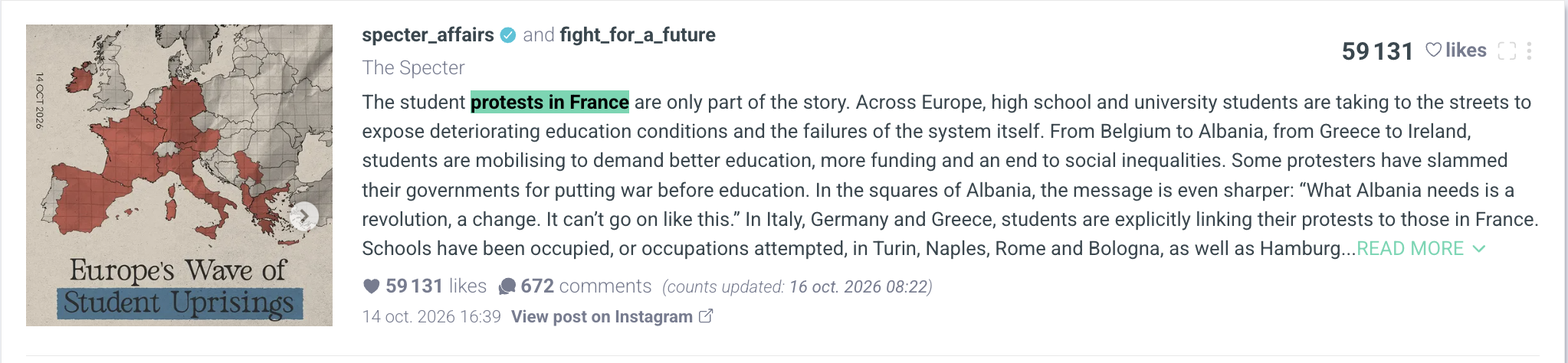
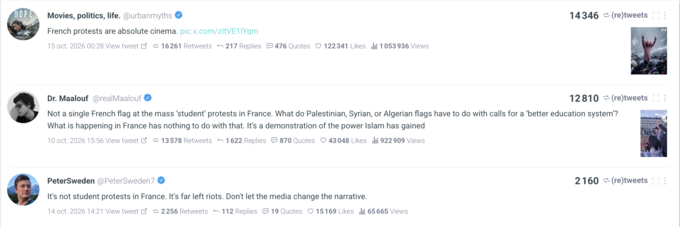
On X, the international conversation takes a different direction. Among the most visible posts, some users are mocking the protests, while others are characterising them as "far left". Others are focusing on the presence of flags associated with various Islamic countries and questioning what they represent within the demonstrations.
The result is a much more fragmented international narrative. While the French conversation is increasingly concerned with who is mobilising, where they are mobilising and what is planned for 17 October, English-language audiences are often more focused on what the protests represent politically.
The high-school protests are becoming part of a much broader mobilisation in France. As different groups and grievances come together ahead of 17 October, the focus is shifting from the original student movement towards a wider expression of political and social dissatisfaction.
But conversations like these rarely stay within national or linguistic borders. As a story gains momentum, it can quickly be picked up by international audiences, reframed through a different political or cultural lens, and connected to wider global narratives. That is already beginning to happen with France's protests.
This is where social listening becomes particularly important: not only to understand what is being said at home, but to track how a story travels, how its meaning changes between audiences, and when a domestic issue starts becoming part of a much bigger international conversation.
Newsletter
.png?width=1090&height=1330&name=CTA%20newsletter%20(1).png)