Reputation Management
Effortlessly and accurately track the web and social network impact of your brand

Why Visibrain
Our Coverage
The best coverage across the web and social networks
Our Technology
Our intuitive interface uses cutting-edge technology
Our Support
Our team is with you every step of the way
Featured
5 Easy Steps to choose the Right Social Listening Tool

Learn more
Our clients
Brands
Visibrain for brands
Institutions & Local Authorities
Visibrain for institutions and local authorities
Agencies
Visibrain for agencies
Success Stories
Discover how our clients use Visibrain
Client stories
How LVMH is using LinkedIn monitoring to boost its influence with Visibrain

Read the case study
Resources
Blog
Stay up to date
White Papers
Studies, industry analysis and advanced insights
Case studies
Our client stories
Help center
Guides and resources for users
Newsletter
Stay up to date with the latest Visibrain news!
Webinars
Our upcoming webinars.
Our Last Study
Employee Advocacy Tracking Toolkit

Download the full guide

On 6 October, ASOS customers received an unauthorised push notification warning that the online fashion retailer had been hacked. The message, which linked to a Telegram channel operated by a group calling itself Xuanye Group, claimed that the attackers had compromised company data. ASOS subsequently confirmed that an unauthorised party had obtained an employee's login credentials through impersonation and accessed information on third-party platforms, exposing some customer details, including names and contact information.
Before the incident, online discussion around ASOS averaged approximately 250 mentions per day. On 6 October, that figure climbed to almost 8,000, representing an increase of around 32 times the usual daily volume. Over the course of a week, the subject generated approximately 12,000 tweets, illustrating the scale of attention directed towards the incident.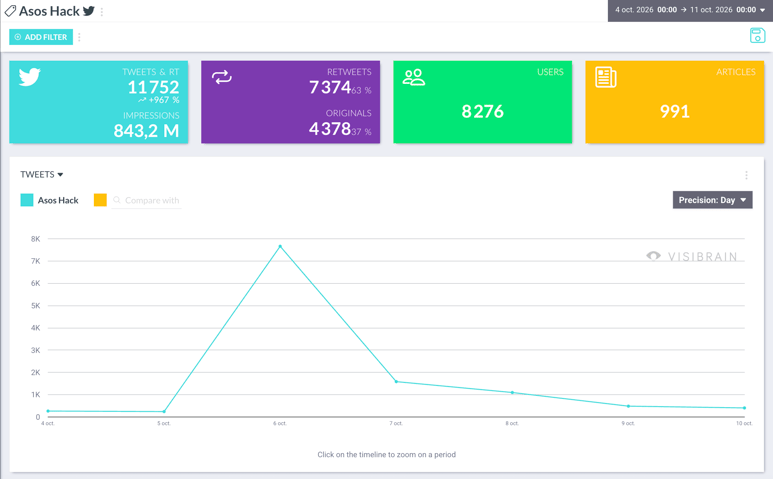

The hashtags associated with the ASOS incident offer another perspective on how the conversation developed. Among the most popular were #cyberattack, #databreach, #onlinesafety and #computerforensics. These terms place the incident within a broader cybersecurity discussion, extending beyond the brand itself to questions of data security, online safety and digital investigation.
For OSINT analysts, identifying these recurring terms is a starting point rather than an end in itself. Examining the posts behind them can help distinguish news reporting from first-hand accounts, security advice, unverified claims and speculation about the extent of a breach.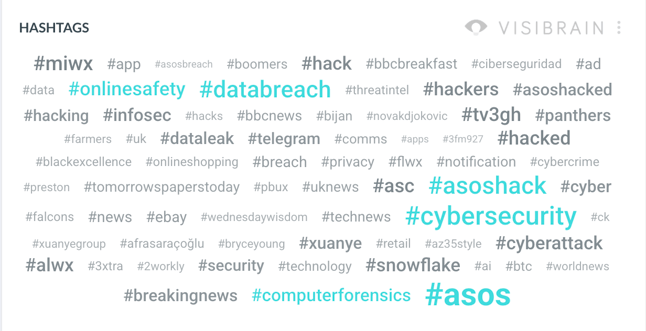
Although online activity declined from its peak, it did not immediately return to its previous level. In the aftermath of the attack, discussion remained at around 400 posts per day. This is approximately 60% above the pre-incident baseline, suggesting that the incident continued to generate attention after the initial surge.
For cyber threat intelligence teams, this continued activity is an important reason to maintain monitoring beyond the first wave of reports. New claims may emerge, information may be recirculated and the discussion may shift as further details become public. Tracking these changes can help analysts identify developments that warrant closer examination. It can also reveal which aspects of an incident continue to attract attention and where new information might enter the public conversation.
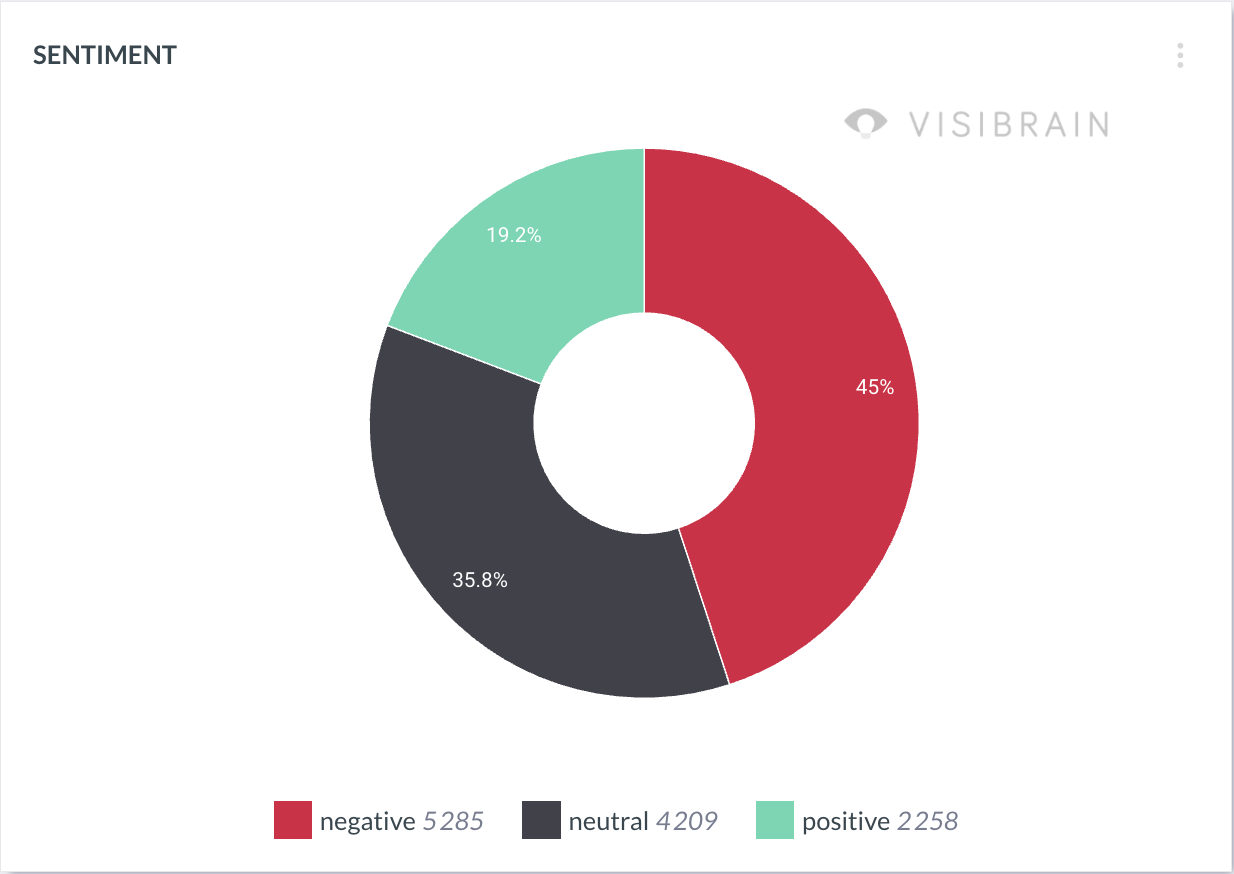
The incident also coincided with a marked change in the sentiment of the online conversation around ASOS. Before the attack, negative sentiment accounted for approximately 11% of mentions. During and after the incident, this share rose to 45%, an increase of 34 percentage points.
While sentiment analysis cannot establish the technical severity of a cyberattack, it can provide additional context about how the incident is being received publicly. Combined with topic analysis and the evolution of discussion over time, it helps distinguish a short-lived burst of attention from a conversation that continues to evolve.
The incident highlights how social listening can help organisations track the evolution of a cyberattack beyond the initial breach. By monitoring online conversations in real time, security and intelligence teams can identify sudden spikes in activity, follow emerging discussions and understand how information about an incident spreads across platforms. In the case of ASOS, Visibrain data offers a closer look at how the conversation unfolded, from the initial surge in mentions to the continued discussion in the days that followed.
Newsletter
.png?width=1090&height=1330&name=CTA%20newsletter%20(1).png)